Vermont / New Hampshire News

Pollination Frenzy

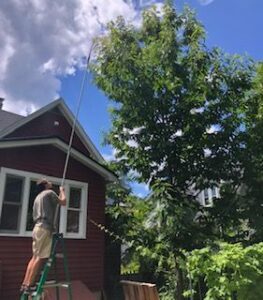
The VT/NH Chapter of TACF recently completed an ambitious American chestnut pollination season. Eight wild trees were cross-pollinated in seven different towns.

Craig Tufts, pictured, pollinated a tree that he planted in his Concord, NH back yard seven years ago. Tim Elliot worked with landowner, Bruce Wilson, to pollinate a tree on Bruce’s Dover NH property. Our thanks to Bruce for leading us to this tree.

The blue ribbon goes to Chapter Location Committee member Chris Leask who pollinated six trees: two in Mason, and one each in Greenville, Temple, Wilton and Merrimack. All in NH.

Thanks to everyone who came forward in response to our call, letting us know the status of trees you own or know of, and the locations of new ones. We couldn’t pollinate every tree, but yours may be a target next year or the year after. The availability of members who know how to pollinate, accessibility without a lift, proximity and timing are all challenges every year, and we’ll endeavor to do better matching resources for this annual “dating game” each year.

Nuts from these trees will be harvested in late September, stored over winter and potted in February. Their saplings will be planted in Chapter Germplasm Orchards (GCO) early next summer. Trees growing in GCOs are pure American chestnuts. Those that survive chestnut blight long enough to flower will be pollinated with transgenic chestnut pollen following Federal approval for distribution of the blight-tolerant transgenic tree developed by the College of Environmental Science and Forestry at SUNY Syracuse.

TACF and its 17 Chapters are currently planting GCOs and developing strategies for introducing trees grown in them all across the historic American chestnut range. This biotechnology approach to restoration is the most promising option for widespread restoration. Nobody ever said it would be easy.


Vermont / New Hampshire News Chapter Menu

National Facebook

Comments Box SVG iconsUsed for the like, share, comment, and reaction icons

We love to see so many people come together for American chestnut restoration.Back in August, Meadowview Research Farm staff members Lucinda Wigfield and Brian Henrich attended the NE-2333 meeting: Biological Improvement of Chestnut through Technologies that Address Management of the Species and its Pathogens and Pests. The meeting provided an opportunity to connect with fellow researchers, learn from a variety of presentations, and share in the latest developments in chestnut research and restoration.
As part of the meeting, Lucinda and Brian also joined a field trip to Johns Creek, getting an up-close look at chestnut research and restoration efforts in the field.
We’re glad that Meadowview staff were able to learn with other scientists and to be part of the ongoing work to restore this important native tree!
#MeadowviewResearchFarm #AmericanChestnut #ChestnutResearch #ChestnutRestoration #NE2333 #ForestRestoration #NativeTrees
... See MoreSee Less

We love to see so many people come together for American chestnut restoration.

Several chestnut enthusiasts recently had the opportunity to visit John's Creek's planting in Virginia. One of the most memorable sights was the claw marks left by black bears foraging for chestnuts as they prepare for winter, a testament to the planting's success and its growing role in supporting wildlife. The visit took place during this year's NE2333 annual meeting.

#AmericanChestnut #ChestnutRestoration #ForestHealth #WildlifeConservation #HealthyForests
... See MoreSee Less

Several chestnut enthusiasts recently had the opportunity to visit Johns Creeks planting in Virginia. One of the most memorable sights was the claw marks left by black bears foraging for chestnuts as they prepare for winter, a testament to the plantings success and its growing role in supporting wildlife. The visit took place during this years NE2333 annual meeting.#AmericanChestnut #ChestnutRestoration #ForestHealth #WildlifeConservation #HealthyForests

6 CommentsComment on Facebook

Have seen a number of true wild, pure American chestnut trees damaged by black bear. These trees are large enough to survive multiple years of “attacks” by black bear.

Hopefully the damaged bark does not serve as a corridor for the blight to enter living tissue.

Are these engineered trees or crossbred?

View more comments

This excellent article takes a deep dive into the history of the American chestnut, the science driving restoration efforts, and the communities helping make recovery possible. Be sure to read the perspectives shared by TACF Director of Science Jared Westbrook, Board Member Jim Searing, and PA/NJ Chapter member Mike Aucott. 🌳🌰

Read the article: rivertownsmagazine.com/stories/the-return-of-the-american-chestnut-tree,146154

#americanchestnut #forestry #ForestRestoration #citizenscience #conservation
... See MoreSee Less

This excellent article takes a deep dive into the history of the American chestnut, the science driving restoration efforts, and the communities helping make recovery possible. Be sure to read the perspectives shared by TACF Director of Science Jared Westbrook, Board Member Jim Searing, and PA/NJ Chapter member Mike Aucott. 🌳🌰Read the article: https://rivertownsmagazine.com/stories/the-return-of-the-american-chestnut-tree,146154  #AmericanChestnut #Forestry #ForestRestoration #CitizenScience #Conservation

49 CommentsComment on Facebook

Thanks for sharing! This was a great article and we're glad to be part of the restoration efforts.

I have acreage, but no idea how to purchase these.

I will be pleased if a 100 ft, tall tree with a sweet chestnut can be developed from any of these approaches.

View more comments

The 2026 American Chestnut Symposium is taking shape! The current schedule is live, featuring expert presentations, panel discussions, restoration updates, networking opportunities, and field tours designed to bring our community together around the future of American chestnut restoration

Have research, restoration work, or a project to share? Consider participating in the poster session and connecting with fellow scientists, volunteers, conservation professionals, and chestnut enthusiasts.

Learn more, explore the schedule, and register today at tacf.org/2026-american-chestnut-symposium/

#ForestRestoration #conservation #forestry #nativespecies #americanchestnut
... See MoreSee Less

The 2026 American Chestnut Symposium is taking shape! The current schedule is live, featuring expert presentations, panel discussions, restoration updates, networking opportunities, and field tours designed to bring our community together around the future of American chestnut restorationHave research, restoration work, or a project to share? Consider participating in the poster session and connecting with fellow scientists, volunteers, conservation professionals, and chestnut enthusiasts.Learn more, explore the schedule, and register today at https://tacf.org/2026-american-chestnut-symposium/ #ForestRestoration #Conservation #Forestry #NativeSpecies #AmericanChestnutImage attachmentImage attachment+2Image attachment

1 CommentComment on Facebook

I will do my best to make it!

Load more