Indiana News

Indiana Chapter in the December Sprout

The meeting was hosted by Carroll Ritter, the Sycamore Land Trust Environmental Education Coordinator, and the Southern Hills Restoration Branch. Members discussed the important of restoring the American chestnut while enjoying a tasty lunch and scenic views. They also had the opportunity to see Indiana chapter member and USFS firefighter Ron Doyle’s restored 1936 Chevy Apache with a custom, American chestnut dashboard. Doyle’s family had chestnut trees on their nearby farm, and remnants of fallen trees can still be found on the forest floor nearly 70 years later.

eating_off_the_tree

Indiana chapter members eating chestnut right off of a tree in the Indiana Department of Natural Resource’s Vallonia Nursery. Photo by Ben Finegan.

The group then toured the nearby Indiana Department of Natural Resource’s Vallonia Nursery. One of the best nurseries east of the Mississippi, the sandy soils of Vallonia grow tens of thousands of TACF Restoration Chestnuts 1.0. Indiana chapter member Jim McKenna led the tour, and discussed the recent pruning improvements to “tame” the rampant growth of the seedlings into more manageable sizes.

Participants from the Indiana chapter fall meeting visiting the breeding orchard in Jackson-Washington State Forest. Photo by Stephanie Eft.

Participants from the Indiana chapter fall meeting visiting the breeding orchard in Jackson-Washington State Forest. Photo by Stephanie Eft.

After the nursery, the tour went back up into a portion of the Jackson-Washington State Forest to visit one of Indiana’s breeding orchards and a BC3F3 progeny test. The breeding orchard holds promising specimens with good form that maintain blight resistance several years after inoculation. While eating raw chestnuts off the trees, the group was treated to a rare find: a large Imperial Moth caterpillar nestled among the chestnut leaves!
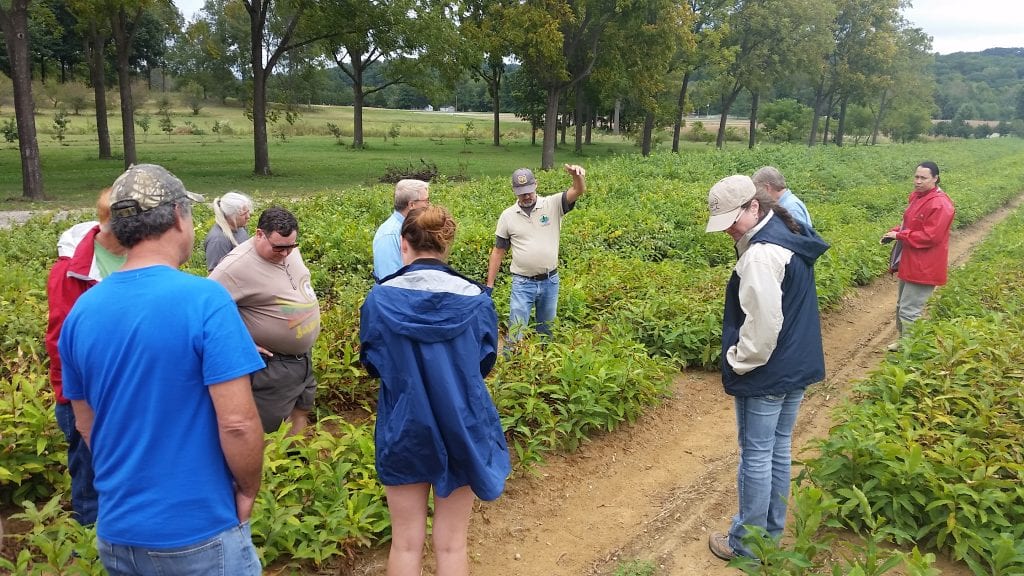
Jim McKenna explains the height that Restoration 1.0 Chestnut trees would grow to without the twice a year pruning. Photo by Ben Finegan.

Jim McKenna explains the height that Restoration 1.0 Chestnut trees would grow to without the twice a year pruning. Photo by Ben Finegan.

While examining the leftovers of eight-foot tall Johnson grass and vines, the group commiserated over war stories of the recent progeny tests. The first half of the summer saw 20 inches of rain in a little more than a month, while the second half saw a near drought. All-in-all, the trees were well cared for and are in a great place to start the 2016 growing season.

The day concluded with a drive just down the road to Salem High School. Greg McCurdy and two science club students gave our group a tour of their 60-acre outdoor science lab which includes planting of nearly 100 American and hybrid chestnut trees.


Indiana News Chapter Menu

National Facebook

Comments Box SVG iconsUsed for the like, share, comment, and reaction icons

Learn more about this remarkable standing American chestnut in the article “We The People: How Iowa Is Part of the Effort to Save the Rare American Chestnut Tree.” Courtesy of Grace Vance and KCRG.

Visit: www.ktiv.com/2026/01/12/we-people-how-iowa-is-part-effort-save-rare-american-chestnut-tree/

#americanchestnut #chestnuts #restoration #conservation #explorepage
... See MoreSee Less

59 CommentsComment on Facebook

Georgia has a stand of chestnut trees in a secret location. Can they borrow some pollen from this tree to add to their breeding collection? They need a varied gene pool for the future.

A guy named Bill Deeter has just recently observed that trees that have crown gall seem to be warding off the blight. Im really hoping that this will bring back the longevity of the American Chestnut

My Neighbors have a vet old chestnut tree - they have contacted several conservation groups about getting a sapling of a second . So it would produce chestnuts once again-

View more comments

A month ago, our President and CEO, Michael Goergen, got to visit the New York Botanical Garden and see the original documentation of chestnut blight taken from a tree in the Bronx Zoo. Feeling a sense of inspiration from the experience, Michael wrote, "Holding that bark brings both grief and resolve. Grief for what was lost. Resolve for the work ahead.

Because for the first time since 1905, we are no longer documenting decline.
We are documenting return.

The American chestnut is not a memory. It is a restoration mission and The American Chestnut Foundation is building the tools and partnerships to finish what Merkel, Murrill, and others could not.

Seeing the original blight records didn’t make the work feel more challenging. It made it feel inevitable.

Restoration is the next chapter. We get to write it."

#explorepage #americanchestnut #history #chestnuts #learn #nature #forestry #trees #blight #restoration #conservation
... See MoreSee Less

A month ago, our President and CEO, Michael Goergen, got to visit the New York Botanical Garden and see the original documentation of chestnut blight taken from a tree in the Bronx Zoo. Feeling a sense of inspiration from the experience, Michael wrote, Holding that bark brings both grief and resolve. Grief for what was lost. Resolve for the work ahead.Because for the first time since 1905, we are no longer documenting decline.We are documenting return.The American chestnut is not a memory. It is a restoration mission and The American Chestnut Foundation is building the tools and partnerships to finish what Merkel, Murrill, and others could not.Seeing the original blight records didn’t make the work feel more challenging. It made it feel inevitable.Restoration is the next chapter. We get to write it.#explorepage #americanchestnut #history #chestnuts #learn #nature #forestry #trees #blight #restoration #conservationImage attachmentImage attachment+1Image attachment

2 CommentsComment on Facebook

Whoo hoo! Sorry, you were not the first to know this. The Chestnut Lady.

Our New England Regional Science Coordinator, Deni Ranguelova, made an appearance on the podcast "Across the Fence" to discuss the American chestnut tree and why we are working to restore them.

Check out the podcast on Youtube at youtu.be/c9EeOc5WIaE?si=80CQtoY4-qeQhjtI

#americanchestnut #chestnuts #podcast #history #restoration #conservation #nature #forestry #explorepage
... See MoreSee Less

4 CommentsComment on Facebook

So like Covid?

I have 70+ new Dunstan hybrids going in this spring, sprouted in my fridge in peat moss right now. They're going out into a 1 acre area on my 18 acres of wooded land in the Poconos. I'm planning to add Italian and Chinese chestnuts next year and let the natural pollination process produce its own hybrids and resistance over time.

This was all because someone in upstate Delaware thought it would be a good idea to grow a Chinese chestnut in their yard so they could show it off to their friends.

New year, new opportunities! Now’s the perfect time to get involved with the American chestnut. 🌱

Check out our January & February events and join the movement!

Visit out events calendar for more info on each event

#americanchestnut #events #volunteer #pennsylvania #castaneapa #Maine #rhodeisland #pennstate #chestnuts #explorepage
... See MoreSee Less

New year, new opportunities! Now’s the perfect time to get involved with the American chestnut. 🌱Check out our January & February events and join the movement!Visit out events calendar for more info on each event#americanchestnut #events #volunteer #pennsylvania #castaneapa #Maine #rhodeisland #pennstate #chestnuts #explorepageImage attachmentImage attachment+2Image attachment

TACF is hiring both a Mid-Atlantic and Southern Regional Science Coordinator! Support volunteer-led science programs, work hands-on with chestnut restoration, and connect regional chapters with national research efforts. If you have experience with tree breeding and selection programs, leading volunteer events, orchard management, or are passionate about the return of American chestnut to its native range, we encourage you to apply.

The link to apply and more details can be found here: tacf.org/employment/
... See MoreSee Less

TACF is hiring both a Mid-Atlantic and Southern Regional Science Coordinator! Support volunteer-led science programs, work hands-on with chestnut restoration, and connect regional chapters with national research efforts. If you have experience with tree breeding and selection programs, leading volunteer events, orchard management, or are passionate about the return of American chestnut to its native range, we encourage you to apply.  The link to apply and more details can be found here: https://tacf.org/employment/Image attachment
Load more