
A New Era in Conservation: Healthy Genomes Accelerate the Next 30 Years of American Chestnut Restoration
The American Chestnut Foundation adopts recurrent genomic selection as the long-term engine of species restoration

[Asheville, NC] — A major new paper published this week in Science marks a turning point in how endangered species can be restored. The research demonstrates that approaches informed by detailed genomic information, long used in agriculture and animal breeding, can be applied at scale to conservation and restoration of wild species, accelerating progress toward restoring ecological integrity.
“For decades, conservation genetics focused on preserving what remained,” said Dr. Jared Westbrook, lead author of the study and the Foundation’s Director of Science. “Genomic tools now allow us to actively design restoration programs that improve with each generation. That shift changes what is possible. We can move from static preservation toward dynamic recovery.”
For The American Chestnut Foundation (TACF), this is not a conceptual milestone, it is the scientific validation of a strategic framework the organization has been building toward for years, through the dedicated work of hundreds of volunteers and affiliated chapters.
“This paper demonstrates that restoration can move from hopeful experimentation to disciplined, precision-guided science,” said Michael Goergen, President & CEO of TACF. “We are formalizing genomic restoration as the foundation of our work for generations.”
At the center of TACF’s strategy is recurrent genomic selection (RGS) — a method that has driven dramatic gains in crops, livestock, and forestry in terms of disease-resistance, productivity, growth rates, and even taste. TACF is adapting this proven approach to conservation biology, creating a system that blends field ecology, advanced genetics, and long-term stewardship by focusing on improving disease resistance while retaining regional genetic diversity.
“Recurrent genomic selection lets us predict which trees will perform best before they reach maturity,” Westbrook said. “That shortens breeding cycles and increases precision. It’s a method proven in agriculture and forestry, and applying it to conservation allows restoration to operate at a scale and efficiency we’ve never had before.”
Unlike short-cycle agricultural systems, forest restoration operates on tree time. Progress unfolds over decades and genetic diversity and ecological interactions are valued rather than selected against. TACF’s approach accepts that reality and builds a program designed for sustained, cumulative improvement rather than quick wins.
“Chestnut restoration is not a single breakthrough moment,” Goergen said. “It’s a compounding process. Each generation becomes stronger, more resilient, and better adapted. Our job is to design a system that keeps improving long after any one of us is gone.”
The organization’s genomic restoration framework integrates:
-
- Large-scale seed orchards designed for iterative improvement
- Advanced phenotyping and field trials
- Predictive genomic modeling
- Long-horizon breeding pipelines
- Ecological deployment strategies grounded in real forests
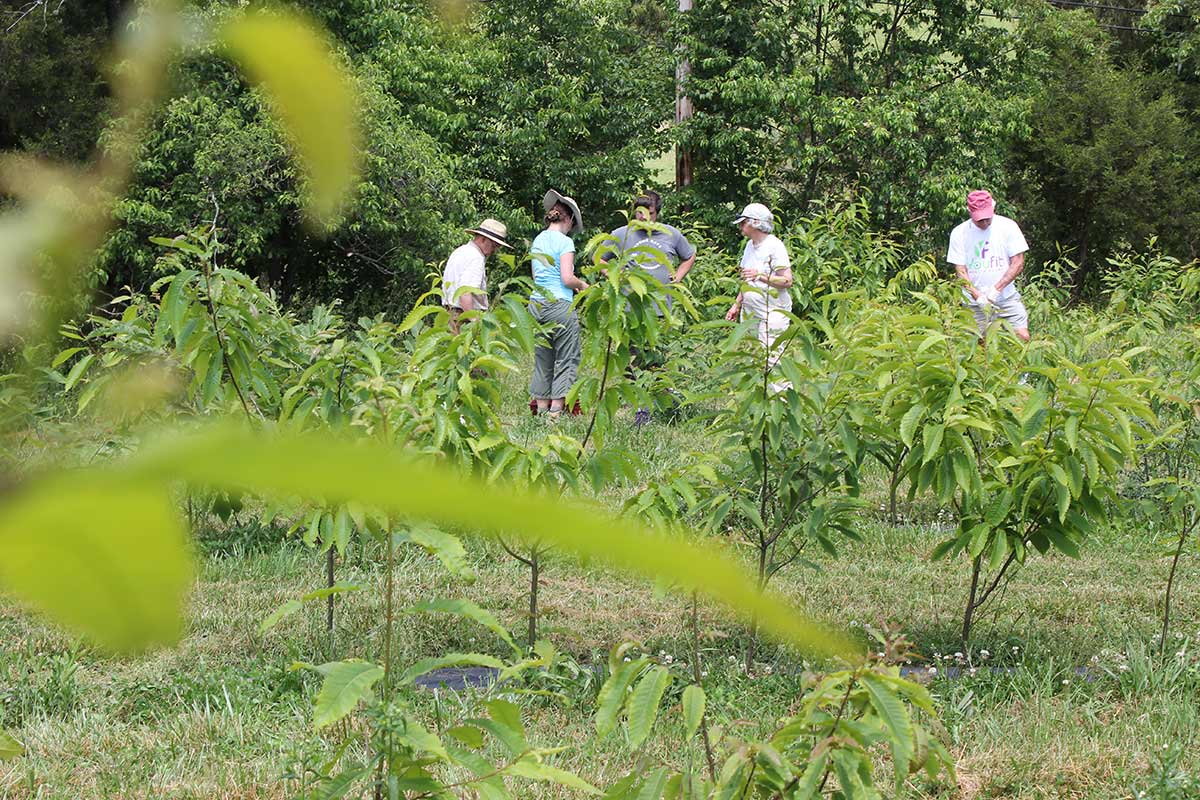
This model represents a shift in conservation thinking: from reactive rescue toward engineered resilience. It also takes advantage of one of TACFs most important assets, foundation and chapter orchards distributed throughout the historic range of the native American species.
In an era that celebrates speed, TACF is choosing endurance. Forest restoration is not a sprint toward novelty; it is a long walk measured in seasons, storms, and soil.
“We are committing to a steady course,” Goergen said. “The work will outlast trends, technologies, and headlines. What matters is that each generation is stronger than the last.”
As climate and landscapes shift, the restoration pipeline itself becomes a living system that learns, adjusts, and improves with time.
“The future forests will not look exactly like the past,” Goergen said. “They will be shaped by the world they grow into. Our job is to give them the capacity to thrive there.”
“Conservation often struggles because it depends on isolated projects,” Goergen said. “We are building infrastructure. A restoration engine. A base program that will still be running 30 years from now, continuously improving.”
The implications extend beyond the American chestnut. The framework emerging from this work offers a template for restoring threatened tree species worldwide.
“This is about proving that conservation can operate with the discipline of a breeding program and the patience of a forest,” Goergen said. “We are designing restoration as an institution, not an experiment.”
The Science publication signals that restoration by RGS models is no longer speculative, it is operational. For TACF, it formalizes a long-term commitment: a stable, science-driven platform that defines the organization’s identity and mission moving forward.
“Our future is not a single tree,” Goergen said. “Our future is a system that keeps making better trees, generation after generation.”
About The American Chestnut Foundation
The American Chestnut Foundation is a nonprofit organization dedicated to restoring the American chestnut to its native forests using advanced breeding science, ecological research, and long-term stewardship. Founded in 1983, TACF integrates genetics, field science, and conservation strategy to rebuild a keystone species and the ecosystems that depend on it.
Media contact:
Jules Smith (gro.fcat@htims.seluj)
Director of Communications
The American Chestnut Foundation