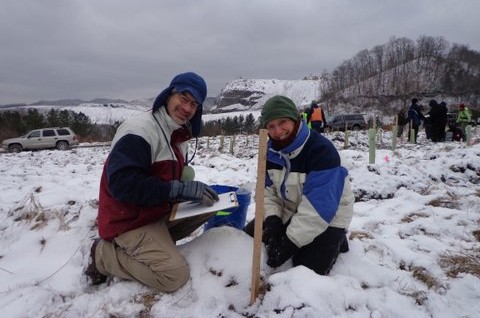
 Forty volunteers and organizers braved snow, cold, and wind to plant a total of 625 chestnut seeds, including 525 Restoration Chestnut 1.0 seeds, on Saturday, March 2, 2013, on the Mullins/McFall reclaimed surface mine site in Dickenson County, near Clintwood, Virginia. Boy Scouts of America Troop 604 brought 10 Scouts and leaders who helped plant and they also built a bonfire to help volunteers keep warm. The Southwest Virginia Restoration Branch of The American Chestnut Foundation (TACF) helped organize the event and will participate in future monitoring. The group included 18 volunteers associated with the Branch. Freddie and Karen Mullins, two of the landowners, also participated by donating stakes for planting and hot chocolate to the volunteers and organizers.
This site includes 22.5 acres, with a progeny test of Restoration Chestnuts 1.0 covering 1 acre and a silvicultural demonstration on the remaining 21.5 acres. The reclaimed surface mine site had been treated to remove existing vegetation and “ripped” by a bulldozer to loosen the packed soil to provide a suitable site for tree growth. The 1-acre progeny included pure American, pure Chinese, and chestnut seed from different stages of TACF’s breeding program (625 chestnuts total). Locations and identification of each seed were recorded for future monitoring. The progeny test will be fenced to exclude deer browsing. In addition to the chestnut seeds, the group planted over 100 mixed hardwood seedlings adjacent to the acre containing the progeny test, including 50 American elms that are potentially resistant to Dutch elm disease. Professional tree planters will plant a mix of bareroot seedlings for the silvicultural demonstration, including Restoration Chestnuts 1.0, at a density of 20 trees per acre, across the rest of the site.
In preparation of the planting, the Branch hosted a free talk on American chestnut restoration and surface mine restoration on Friday, February 22, in the conference room of the Abingdon Branch of the Washington County Public Library. Attendees learned about the history of the American chestnut and were updated on TACF’s breeding program from TACF Chief Scientist, Dr. Fred Hebard. TACF Forester, Michael French presented the history of mine reclamation and the role that reclamation may play in chestnut restoration. Forty people attended the talks and several volunteered to help with the Mullins/McFall site planting.
The planting near Clintwood, Virginia, is funded in part by a Conservation Innovation Grant awarded to The American Chestnut Foundation (TACF) from the USDA Natural Resources Conservation Service to establish forest trees, including American chestnut, on 12 reclaimed mine sites in Appalachia. In addition to reforesting damaged mine lands, this project will help determine the best methods for restoring the newly developed potentially blight-resistant chestnuts (called Restoration Chestnuts 1.0) that are the result of 30 years of research and breeding by TACF. The testing and monitoring of chestnuts in mineland reforestation efforts is the result of a partnership between TACF, The Virginia Department of Forestry (VDOF), the Appalachian Regional Reforestation Initiative and Green Forests Work. The VDOF was responsible for preparing the site and planting the hardwood species on the site.