Vermont / New Hampshire News

ME and VT/NH Chapters coordinate to advance chestnut restoration!

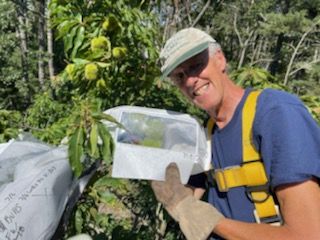
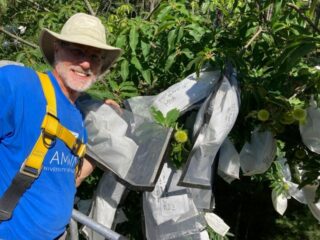
On August 24-25, 2021 Maine Chapter VP, Tom Klak, and VT/NH Chapter President, Doug McLane, once again combined efforts to move American chestnut restoration forward. They checked the condition of hundreds of chestnut flowers at Cape Elizabeth, Maine that they had pollinated earlier with transgenic pollen. This was one more important step in the transgenic chestnut experiment underway at the University of New England (UNE) through Dr. Klak’s leadership. His work is closely coordinated with the College of Forestry and Environmental Science at SUNY Syracuse where the transgenic chestnut was developed.

When the pollinated nuts mature they will be harvested and each one painstakingly analyzed to determine which ones have inherited the transgenic tree’s oxidase enzyme that will allow the next generation to tolerate chestnut blight. About half of the nuts typically inherit the gene.

All TACF Chapters are actively locating nut-producing wild American chestnuts and planting their nuts in Germplasm Conservation Orchards. Trees grown from these nuts will be pollinated with transgenic pollen once it is approved for distribution by Federal agencies. Dr. Klak’s work at UNE is tightly controlled under strict USDA permits.

Pollinating and harvesting hundreds of chestnuts is difficult and labor intensive work. Tom and Doug’s efforts are greatly appreciated!.
 

Vermont / New Hampshire News Chapter Menu

National Facebook

Comments Box SVG iconsUsed for the like, share, comment, and reaction icons

There’s nothing quite like the first signs of life in the nursery; our chestnut seedlings are officially emerging! After weeks of careful stratification, planting, and patience, we’re starting to see those first tender shoots break through the soil. Early seedling emergence is a critical stage, showing us that germination was successful and that strong root systems are beginning to establish beneath the surface. These seedlings will be used for our Recurrent Genomic Selection program, including future seed orchards, progeny tests, small stem assays, phytophthora root rot screening. Here’s to healthy growth, strong roots, and a thriving season ahead! #AmericanChestnut #RestorationInProgress #ChestnutResearch #ForestRestoration #MeadowviewResearchFarms #ConservationScience ... See MoreSee Less

There’s nothing quite like the first signs of life in the nursery; our chestnut seedlings are officially emerging! After weeks of careful stratification, planting, and patience, we’re starting to see those first tender shoots break through the soil. Early seedling emergence is a critical stage, showing us that germination was successful and that strong root systems are beginning to establish beneath the surface. These seedlings will be used for our Recurrent Genomic Selection program, including future seed orchards, progeny tests, small stem assays, phytophthora root rot screening. Here’s to healthy growth, strong roots, and a thriving season ahead! #AmericanChestnut #RestorationInProgress #ChestnutResearch #ForestRestoration #MeadowviewResearchFarms #ConservationScience ... See MoreSee Less

1 CommentComment on Facebook

Meadowview for the Win!🏆

Grafting is one of the tools we use to conserve large, surviving American chestnut germplasm and ensure it isn’t lost. By grafting scion from important trees onto compatible rootstock, we can preserve valuable genetics and share this germplasm across regions. This work allows exceptional trees to live on in multiple locations, supporting research, restoration, and collaboration while safeguarding the diversity of the American chestnut for the future.

#AmericanChestnut #RestorationInProgress #ChestnutResearch #ForestRestoration #MeadowviewResearchFarms #ConservationScience
... See MoreSee Less

Our Director of Science, Jared Westbrook, was interviewed by Ira Flatow, founder and host of Science Friday, for their podcast. The episode is now available: www.sciencefriday.com/segments/restoring-american-chestnut-tree/

On Science Friday, Jared discusses the multiple approaches taken to improve blight resistance in American chestnut trees, TACF’s recurrent genomic selection program as our main engine for restoration, and what successful restoration looks like.

#americanchestnut #sciencefriday #science #restoration #explorepage #conservation
... See MoreSee Less

Black History Month provides an important opportunity to honor the past while also recognizing how Black knowledge, leadership, and community continue to shape the present. From histories rooted in land and survival to modern platforms and outdoor spaces where connection and representation matter.

Today we’re highlighting Hattie Carthan, who fought against the impacts of redlining and disinvestment by mobilizing her Bed‑Stuy community to restore its trees and protect a landmark magnolia. Her legacy shows that restoration starts with us, an idea at the heart of our work to revive the American chestnut.

Read more about Hattie Carthan: tacf.org/black-history-and-the-american-chestnut/

#blackhistorymonth #americanchestnut #treestagram #explorepage #nature
... See MoreSee Less

Black History Month provides an important opportunity to honor the past while also recognizing how Black knowledge, leadership, and community continue to shape the present. From histories rooted in land and survival to modern platforms and outdoor spaces where connection and representation matter.Today we’re highlighting Hattie Carthan, who fought against the impacts of redlining and disinvestment by mobilizing her Bed‑Stuy community to restore its trees and protect a landmark magnolia. Her legacy shows that restoration starts with us, an idea at the heart of our work to revive the American chestnut. Read more about Hattie Carthan: https://tacf.org/black-history-and-the-american-chestnut/ #blackhistorymonth #americanchestnut #treestagram #explorepage #natureImage attachmentImage attachment

1 CommentComment on Facebook

So trees DO grow in Brooklyn again?!

Load more