Vermont / New Hampshire News

Pollination Frenzy

The VT/NH Chapter of TACF recently completed an ambitious American chestnut pollination season. Eight wild trees were cross-pollinated in seven different towns.

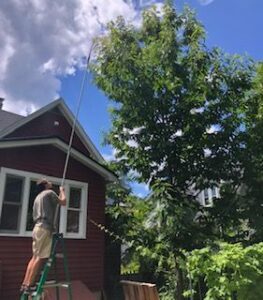
Craig Tufts, pictured, pollinated a tree that he planted in his Concord, NH back yard seven years ago. Tim Elliot worked with landowner, Bruce Wilson, to pollinate a tree on Bruce’s Dover NH property. Our thanks to Bruce for leading us to this tree.

The blue ribbon goes to Chapter Location Committee member Chris Leask who pollinated six trees: two in Mason, and one each in Greenville, Temple, Wilton and Merrimack. All in NH.

Thanks to everyone who came forward in response to our call, letting us know the status of trees you own or know of, and the locations of new ones. We couldn’t pollinate every tree, but yours may be a target next year or the year after. The availability of members who know how to pollinate, accessibility without a lift, proximity and timing are all challenges every year, and we’ll endeavor to do better matching resources for this annual “dating game” each year.

Nuts from these trees will be harvested in late September, stored over winter and potted in February. Their saplings will be planted in Chapter Germplasm Orchards (GCO) early next summer. Trees growing in GCOs are pure American chestnuts. Those that survive chestnut blight long enough to flower will be pollinated with transgenic chestnut pollen following Federal approval for distribution of the blight-tolerant transgenic tree developed by the College of Environmental Science and Forestry at SUNY Syracuse.

TACF and its 17 Chapters are currently planting GCOs and developing strategies for introducing trees grown in them all across the historic American chestnut range. This biotechnology approach to restoration is the most promising option for widespread restoration. Nobody ever said it would be easy.


Vermont / New Hampshire News Chapter Menu

National Facebook

Comments Box SVG iconsUsed for the like, share, comment, and reaction icons

We’re on the Naturally Scott Podcast!
Our President & CEO sat down with Scott to talk about the past, present, and future of the American chestnut — from its historic role in Appalachia to the cutting-edge science driving restoration today.

- Why the roots never died
- The cutting-edge science behind restoration
- Why volunteers and donors are leading this effort

Watch the full episode now and join us in bringing back America’s iconic tree:

www.youtube.com/@NaturallyScott

podcasts.apple.com/us/podcast/naturallyscott/id1830513032
... See MoreSee Less

We’re on the Naturally Scott Podcast!
Our President & CEO sat down with Scott to talk about the past, present, and future of the American chestnut — from its historic role in Appalachia to the cutting-edge science driving restoration today.

- Why the roots never died
- The cutting-edge science behind restoration
- Why volunteers and donors are leading this effort

Watch the full episode now and join us in bringing back America’s iconic tree:

www.youtube.com/@NaturallyScott

podcasts.apple.com/us/podcast/naturallyscott/id1830513032
... See MoreSee Less

🐛 Large silk moth caterpillar native to North America, not a threatened species fairly common *but beautiful.
🌳 Tree is a wild American chestnut planted for a PRR fungicide trial in Clemson, SC.

Photo credit: Celeste Giles, Research Associate with the Plant and Environment Sciences Department at Clemson
#americanchestnut #explore #nature #bugs #chestnuts #caterpillar
... See MoreSee Less

🐛 Large silk moth caterpillar native to North America, not a threatened species fairly common *but beautiful.🌳 Tree is a wild American chestnut planted for a PRR fungicide trial in Clemson, SC.Photo credit: Celeste Giles, Research Associate with the Plant and Environment Sciences Department at Clemson #americanchestnut #explore #nature #bugs #chestnuts #caterpillarImage attachmentImage attachment

4 CommentsComment on Facebook

Can you tell us more about the PRR fungicide trial?

So cool. Curious if the funguscide harms the catepillar and insects?

Speaking of threat, our local university has discovered the chestnut weevil is not extinct as was thought. www.actionnews5.com/2025/12/08/uofm-researchers-rediscover-weevil-believed-be-extinct-thanks-phot...

In celebration of GivingTuesday, TACF’s Board of Directors and President & CEO Michael Goergen came together to issue a matching gift challenge. The original goal was $5,000, but because of their collective passion and generosity a total of $18,125 has been raised, making the impact of your gift even greater. If that amount is reached, it will double to $36,250! Visit the link in our bio to donate. ... See MoreSee Less

In celebration of GivingTuesday, TACF’s Board of Directors and President & CEO Michael Goergen came together to issue a matching gift challenge. The original goal was $5,000, but because of their collective passion and generosity a total of $18,125 has been raised, making the impact of your gift even greater. If that amount is reached, it will double to $36,250! Visit the link in our bio to donate.

Join the VA chapter for a science presentation, orchard tour and seed give away! This meeting is open to the public and will take place on December 6th at Banshee Reeks Nature Preserve from 1pm-4pm.
Stop by and get some free wild-type American chestnut seeds!
... See MoreSee Less

Join the VA chapter for a science presentation, orchard tour and seed give away! This meeting is open to the public and will take place on December 6th at Banshee Reeks Nature Preserve from 1pm-4pm.Stop by and get some free wild-type American chestnut seeds!

5 CommentsComment on Facebook

What kind of American chestnut seeds?

Very cool! Have fun everyone who can go!

their is one kind only

View more comments

Load more