

Fox Haven Orchard
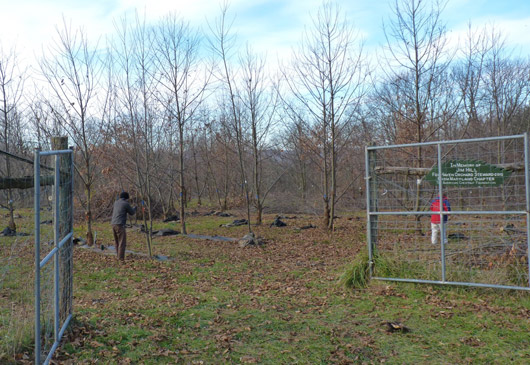
This orchard was inoculated and rouged in 2012 and 2013. The final culling was performed in 2015. Presently, 28 trees across 7 lines remain for open pollination and seed production. They are listed below. These remaining trees were selected for blight resistance and American chestnut characteristics (tall and straight). Seed from these trees have been planted in our seed orchard.
Address:
3630 Poffenberger Rd, Jefferson, MD 21755
(see map below)
Contacts:
Darryl Johnson- steward
Directions:
From intersection of I-270, I -70 and US 15 in Frederick, MD, Take US 15 S/340 W toward Harpers Ferry and Charles Town. Stay on 340 when 15 exits to the left. Take next exit (Jefferson/Lander Road) and keep to
the right. At traffic light, take a left (on MD 180). Take a right onto Old Middletown Road. (This intersection is near the middle of the old town, and is easy to miss. If you get to Hemps and the bakery, you’ve gone too far.) In less than a mile, turn left onto Poffenberger Road. Poffenberger makes a sharp curve to the right. Turn into the next driveway on the right, and follow the driveway uphill and to the left. Park on the asphalt.
Yater11A – 35, 139, 335, 386, 444
HH – 102, 185, 283
T156 – 41, 424, 431, 497
SW901/805 – 29, 142, 435, 504
Knapp – 658, 696, 801, 894
WM47A – 662, 840, 891
Man41A – 714, 715, 734, 939, 942
An Excel spreadsheet map of the Fox Haven orchard is available for downloading here.
The original planting: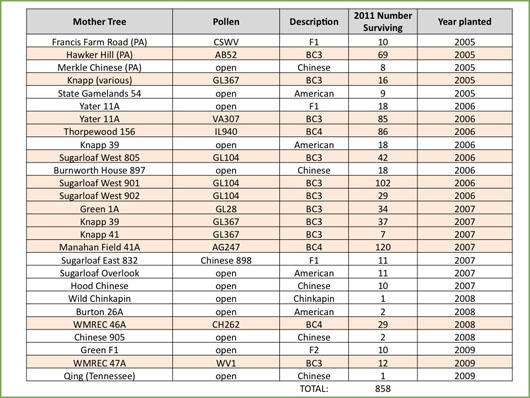
Location:
Maryland Chapter Menu
National Facebook

Unlike most forest trees that rely mostly on wind, American chestnuts recruit insects too.
#americanchestnut #environmentaleducation #pollinator #nativetrees #dronefootage
0 CommentsComment on Facebook
Did you know some plants actually benefit from fire? Recently burned areas often provide the sunlight and reduced competition that species like blueberries and American chestnuts need to flourish.
#americanchestnut #nativeplants #ForestEcology #Conservation #NatureEducation
4 CommentsComment on Facebook
Yes! Across the Eastern US, almost all of our most important keystone , overstory trees are fire adapted (pyrophytic 🔥). (Except in bottomlands/riparian/wetland zones, for the most part). This includes Hickories, the upland Oaks, certain pines, especially Longleaf, and Chestnuts. Many Oaks in particular are struggling with recruitment now due to fire suppression, among many other issues. This process is called mesophycation btw. Mesophytic natives like Maples 're-engineer' forests through their dense, moist leaf litter to retard-fires. Invasives make it worse. This is important because Oaks are THE top keystone plants here, hosting more species of Lepidoptera (Moths and Butterflies) than any other plant genus in the US: 500-900 species. Most of these caterpillars will become inconspicuous "little brown moths" , but they form an important massive bottom-tier of the food pyramid. After all, even though birds can source berries from a variety of plants , it takes 6-9000 caterpillars to raise a single clutch of songbirds.
I really appreciate what you are doing.
Thank you!
PICA, the Printing Industry of the Carolinas Awards, is celebrating its 60th year as the ultimate showcase of excellence in printing, and TACF has something to celebrate too.
Our partner in printing (BP Solutions Group) has entered Chestnut magazine in this competition for nearly 10 years and of those, TACF, BP, and designer Lisa Alford have received an award nearly every year, some of which included multiple awards within the same year!
Chestnut once again received a PICA Award for the 2025 competition, winning “Best of Category” for its “Sheetfed Magazine Series.” TACF is thrilled to have received this honor and to celebrate it with you!
Want to see what this award-winning magazine is all about? Become a member!
#americanchestnut #magazine #science #forestecology #explore

1 CommentComment on Facebook
Big congratulations to you Jules! 🎉🎉 This is a well-deserved honor.
We've prepared a completely legitimate and highly scientific quiz.
Take the quiz, then drop your results in the comments:
🤓 Confidently Wrong
🌱 Chestnut Curious
🌰 Chestnut Expert
#AmericanChestnut #TreeID #ForestEducation #ChestnutTrees #NativeTrees
5 CommentsComment on Facebook
Just a few years apart: the same wild American chestnut tree before and after chestnut blight took its toll.
Enter our 2026 Photo Contest from now until the end of December!
#americanchestnut #chestnutblight #ForestEcology #NativeSpecies #ForestConservation
2 CommentsComment on Facebook