Vermont / New Hampshire News

2026 Annual Meeting Recap

The VT-NH Chapter Annual Meeting took place on May 9, 2026 at Fox State Forest in Hillsborough, NH. The day opened with a welcome by outgoing president Gary Hawley, then a short history of Fox Forest by Inge Seaboyer with the NH Division of Forests and Lands. Michael Goergen, President and CEO of The American Chestnut Foundation spoke next, talking about the status and future of the organization.
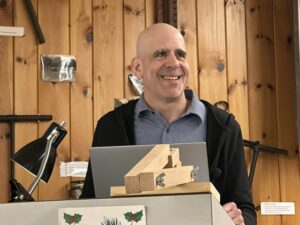
Michael Goergen speaks at a podium

Michael Goergen addresses the VT/NH chapter at the 2026 annual meeting.

Three science presentations followed: Dr. Peter Clark, a Research Associate faculty from the University of Vermont presented on the eight-year performance of American chestnut within climate adaptation experiments. (Slides can be found here). Following Dr. Clark, New England Regional Science Coordinator Deni Ranguelova share a guide to the TACF Recurrent Genomic Selection program (RGS). (Slides here). To wrap up the morning program, chapter president Gary Hawley spoke on chestnut restoration research, highlighting an experiment on chestnut restoration in different silvicultural conditions and forest types (slides here).

After lunch, attendees went on a rainy tour of the Tom Rush Forest chestnut plantings onsite.
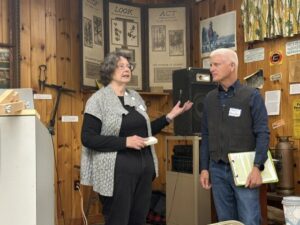
Two speakers stand at the front of a room

The passing of the torch: Outgoing president Gary Hawley and incoming president Marla Binzel address the meeting attendees.
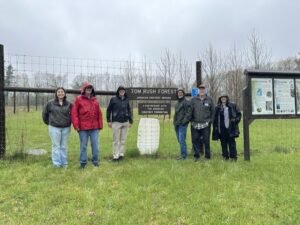
Several people stand in the raing around a sign that reads Tom Rush Forest. In the background is an open field with chestnut trees planted in it.

Meeting attendees brave the rain to check out the planted chestnuts at the Tom Rush Forest at Fox Forest.


Vermont / New Hampshire News Chapter Menu

National Facebook

Comments Box SVG iconsUsed for the like, share, comment, and reaction icons

Just a few years apart: the same wild American chestnut tree before and after chestnut blight took its toll.

Enter our 2026 Photo Contest from now until the end of December!

#americanchestnut #chestnutblight #ForestEcology #nativespecies #ForestConservation
... See MoreSee Less

Just a few years apart: the same wild American chestnut tree before and after chestnut blight took its toll. Enter our 2026 Photo Contest from now until the end of December! #AmericanChestnut #ChestnutBlight #ForestEcology #NativeSpecies #ForestConservationImage attachmentImage attachment+1Image attachment

Please share your stories! ... See MoreSee Less

Please share your stories!Image attachment

American chestnuts produce separate male flowers and bisexual flowers on the same tree?! What a fascinating reproductive strategy for a species once dominant across eastern forests. 🌿

#americanchestnut #treefacts #treeidentification #ForestEcology #SaveOurForests
... See MoreSee Less

3 CommentsComment on Facebook

I have had these on the farm for years

BeeKeeper Mango

From looking at the leaves that is NOT an American chestnut. The leaves do not have the good fishhook profile on the edges, and from what can see they look like Japanese chestnut leaves which have small feathery edges.

Small Stem Assays involve inoculating young chestnut stems with the blight fungus and monitoring the resulting cankers, allowing researchers to assess how well different trees respond to infection.

#educational #Informative #americanchestnut #Fieldwork #explore
... See MoreSee Less

2 CommentsComment on Facebook

You don't find out if the tree is resistant until it matures. That could be a decade later.

I am always amazed how big you all can grow them in 1 year. That is how big my second year seed8 gs always are!

Last week, staff at TACF’s national office in Asheville joined Carolinas Chapter President Peggy McDonald, husband Bob, and Chapter board member Jon Taylor for a hike at Albert Mountain in Western NC to visit wild American chestnut trees in search of flowering catkins.

During their venture, the team also came across a few cool amphibians: a red-legged salamander, which only inhabits portions of the southern Appalachian Mountains, and a red-spotted newt, which is much more common, but its brilliant red is stunning!

Of course, the biggest thrill was seeing large surviving chestnut trees and, as the day wrapped up, collecting some beautiful catkins that were high in the canopy of a tree on the way down the mountain. Pollen collected from the catkins will be used in TACF’s southern region breeding program.

#hike #nature #getoutside #americanchestnut #pollination
... See MoreSee Less

6 CommentsComment on Facebook

Whoa. Fascinating that some mature American Chestnuts have survived the blight. Taking pollen from these survivors is such a great idea. I didn't realize there were any survivors in NC.

Ils sont en fleur au Québec aussi, ça fait du bien de les voir grandir.

Fantastic

View more comments

Load more