West Virginia News

WV chapter work day at the Clements Tree Nursery in Mason County

The state tree nursery in Mason County, WV has two chestnut orchards.  The older orchard was planted in the mid-1970s from nuts from large, surviving American chestnuts in the mid-Atlantic region.  Nuts from the 1970’s orchard were used to initiate a second orchard in the 1990s.  Seeds from the orchards are collected, stratified and grown for sale to the general public.  While the state tree nursery sells all types of trees (oak, maple, sycamore, redbud…) they always sell out of chestnuts very quickly.  Members and friends of the WV chapter gathered in mid-June in an attempt to improve the younger orchard.  Nine individuals, wielding chain saws, loppers and hand saws, made significant progress over a 5-hour period cutting out dead chestnut stems, removing invading Sumac, multiflora rose and Hawthorn trees.  Piles of debris were scattered all over the orchard and everyone went home tired but feeling a sense of accomplishment.  Those assisting were: Dee and Jeanne Quinn (Raleigh County), Martha Snyder (Jackson County), Robert Sypolt and Darrell Dean (Preston County) and Mark and Mindy Double, Amy Metheny and William MacDonald (Monongalia County).

The nursery superintendent, Jason Huffman, can always use help in the fall collecting chestnuts when they fall.  Jason’s contact information is: vog.vw@namffuH.L.nosaJ if you want to help harvest nuts.
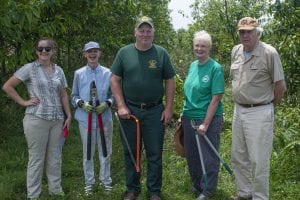
Amy Metheny, Martha Snyder, Jason Huffman (nursery superintendent), Mindy Double and William MacDonald pose for a picture in the orchard.
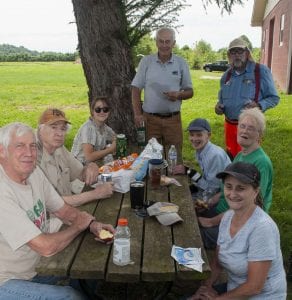
The group takes a lunch break under a Japanese larch. Seated (l to r): Dee Quinn, William MacDonald, Amy Metheny, Martha Snyder, Mindy Double and Jeanne Quinn. Standing are Robert Sypolt and Darrell Dean.
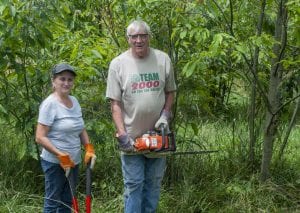
Jeanne and Dee Quinn cut out dead stems from the orchard.
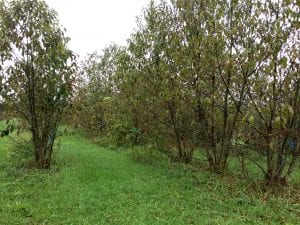
A picture of the orchard prior to removing dead stems and invading species.
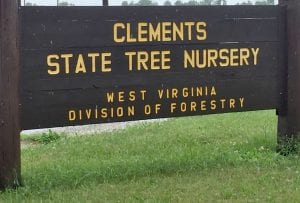
The tree nursery sign on Route 62 along the Ohio River.
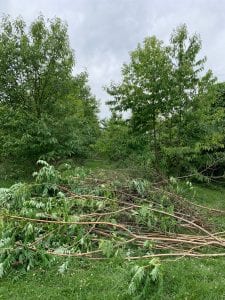
One of many piles of debris.


West Virginia News Chapter Menu

National Facebook

Comments Box SVG iconsUsed for the like, share, comment, and reaction icons

Some say the American chestnut is the only ‘Ten I see.' We say the Chapter Meeting is a close second—RSVP now via the listed website or QR code.

RSVP here: TINYURL.COM/YBVMP5TN

#americanchestnut #Tennessee #TN #cookeville #chestnuts #meeting #event #getinvolved #restoration #conservation #nature #forestry
... See MoreSee Less

Some say the American chestnut is the only ‘Ten I see. We say the Chapter Meeting is a close second—RSVP now via the listed website or QR code. RSVP here: HTTPS://TINYURL.COM/YBVMP5TN #americanchestnut #Tennessee #TN #cookeville #chestnuts #meeting #event #getinvolved #restoration #conservation #nature #forestry

Selecting the best and roguing the rest 🌱🌳These trees were planted 8 years ago, and by carefully choosing which trees to keep and which to remove, we’re creating space for stronger growth and healthier stands. Selected trees will be genotyped for our Recurrent Genomic Selection (RGS) program and could play a key role in future breeding efforts.
#AmericanChestnut #RestorationInProgress #ChestnutResearch #ForestRestoration #MeadowviewResearchFarms #Castanetum #ScienceInTheField
... See MoreSee Less

Selecting the best and roguing the rest 🌱🌳These trees were planted 8 years ago, and by carefully choosing which trees to keep and which to remove, we’re creating space for stronger growth and healthier stands. Selected trees will be genotyped for our Recurrent Genomic Selection (RGS) program and could play a key role in future breeding efforts. #AmericanChestnut #RestorationInProgress #ChestnutResearch #ForestRestoration #MeadowviewResearchFarms #Castanetum #ScienceInTheField

6 CommentsComment on Facebook

Of the 25 first gen Chinese chestnut tress I planted, two survive to produce here in western Pennsylvania. That was ~35-years ago.

A seedling seed orchard: Over time, this combines selecting trees for blight resistance and thinning out (rouging) the susceptible genotypes. This works to produce an orchard seed source. Some reliable resistance, at a spacing favorable for seed production.

The trees in our progeny tests are seedlings of controlled pollinations (we know the moms and the dads) and/or open pollinations (we know only who the mother is) of selected backcross hybrids that result from nearly 40 years of breeding and selection. Selection was based on resistance to Cryphonectria parasitica following direct inoculation of the stems with virulent strains, and on a rubric of morphological characters typical for Castanea dentata (selecting against any C. mollissima morphological traits).

View more comments

🌰 "The evolving story of New Jersey’s chestnuts" by Alison Mitchell
Check out this article that features insights from our North Central Regional Science Coordinator, Lake Graboski, and also highlights New Jersey Nut Farms’ separate hybridization efforts—showing the range of work underway to bring back the American chestnut.

Click the following link to view the full story: www.newsbreak.com/south-jersey-media-302714994/4444458578919-the-evolving-story-of-new-jersey-s-c...

#americanchestnuts #nature #chestnuts #restoration #conservation #quote #article #explorepage
... See MoreSee Less

🌰 The evolving story of New Jersey’s chestnuts by Alison MitchellCheck out this article that features insights from our North Central Regional Science Coordinator, Lake Graboski, and also highlights New Jersey Nut Farms’ separate hybridization efforts—showing the range of work underway to bring back the American chestnut. Click the following link to view the full story: https://www.newsbreak.com/south-jersey-media-302714994/4444458578919-the-evolving-story-of-new-jersey-s-chestnuts #americanchestnuts #nature #chestnuts #restoration #conservation #quote #article #explorepage

16 CommentsComment on Facebook

I have one of the original American chestnuts growing on my land.. it grows to about 12 feet tall and it dies. it comes back from the root and does the cycle again. it's done this for the last 63 years.

I've got a half dozen proven American chestnut trees in the country park across the street. 60 + feet and bear nuts every year by the ton. the nuts seem to be sterile. no saplings ever. .

How far our we from a chestnut that grows past 20 years

View more comments

Learn more about this remarkable standing American chestnut in the article “We The People: How Iowa Is Part of the Effort to Save the Rare American Chestnut Tree.” Courtesy of Grace Vance and KCRG.

Visit: www.ktiv.com/2026/01/12/we-people-how-iowa-is-part-effort-save-rare-american-chestnut-tree/

#americanchestnut #chestnuts #restoration #conservation #explorepage
... See MoreSee Less

72 CommentsComment on Facebook

Georgia has a stand of chestnut trees in a secret location. Can they borrow some pollen from this tree to add to their breeding collection? They need a varied gene pool for the future.

A guy named Bill Deeter has just recently observed that trees that have crown gall seem to be warding off the blight. Im really hoping that this will bring back the longevity of the American Chestnut

My Neighbors have a vet old chestnut tree - they have contacted several conservation groups about getting a sapling of a second . So it would produce chestnuts once again-

View more comments

A month ago, our President and CEO, Michael Goergen, got to visit the New York Botanical Garden and see the original documentation of chestnut blight taken from a tree in the Bronx Zoo. Feeling a sense of inspiration from the experience, Michael wrote, "Holding that bark brings both grief and resolve. Grief for what was lost. Resolve for the work ahead.

Because for the first time since 1905, we are no longer documenting decline.
We are documenting return.

The American chestnut is not a memory. It is a restoration mission and The American Chestnut Foundation is building the tools and partnerships to finish what Merkel, Murrill, and others could not.

Seeing the original blight records didn’t make the work feel more challenging. It made it feel inevitable.

Restoration is the next chapter. We get to write it."

#explorepage #americanchestnut #history #chestnuts #learn #nature #forestry #trees #blight #restoration #conservation
... See MoreSee Less

A month ago, our President and CEO, Michael Goergen, got to visit the New York Botanical Garden and see the original documentation of chestnut blight taken from a tree in the Bronx Zoo. Feeling a sense of inspiration from the experience, Michael wrote, Holding that bark brings both grief and resolve. Grief for what was lost. Resolve for the work ahead.Because for the first time since 1905, we are no longer documenting decline.We are documenting return.The American chestnut is not a memory. It is a restoration mission and The American Chestnut Foundation is building the tools and partnerships to finish what Merkel, Murrill, and others could not.Seeing the original blight records didn’t make the work feel more challenging. It made it feel inevitable.Restoration is the next chapter. We get to write it.#explorepage #americanchestnut #history #chestnuts #learn #nature #forestry #trees #blight #restoration #conservationImage attachmentImage attachment+1Image attachment

2 CommentsComment on Facebook

Whoo hoo! Sorry, you were not the first to know this. The Chestnut Lady.

Load more