Georgia News

Ambrosia beetle time is upon us!

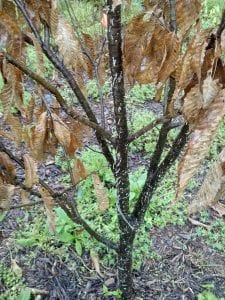
Ambrosia beetle frass strands emerging from a hybrid chestnut at the Rome River EcoCenter.

Chestnut enthusiasts,

Ambrosia beetles may soon appear in our chestnut orchards. These beetles normally start wood boring activity as soon as we get three 70oF days in a row in the early spring (usually early March in Georgia). Boring activity lasts until the trees fully leaf out in mid-April. The beetles spread a fungus into the tree, which then spreads throughout the tree eventually killing it. Activity can be noted by small (+/- 1 mm diameter) circular holes in the bark. Holes may weep sap or may have “toothpicks” of sawdust/insect feces sticking out of the holes. Trees in the stem diameter range of about ½ inch to 4 inches are generally susceptible to attack. Generally attacks occur at about head height down to the base of the tree, although sometimes they get higher in the tree.

A preventative that we use in our backcross orchards is a bark spray using the active ingredient bifenthrin (e.g., Bifen IT). The application rate we use is 0.7 oz of a product containing 8% of the active ingredient per gallon of water. We are also using a bark penetrant called Pentra Bark mixed into the sprayer for greater residual activity. We encourage you to take similar steps to protect your trees if they are in the susceptible size range. We usually try to spray trees once every two weeks from late February until bud break.  Now is the time to begin preparing to combat these pests.

If you do get beetles in your trees, continue to spray all trees, but wait about 30 days, then cut the infested trees to the base (these are the trees that generally fail to leaf out). Remove the trees from the site and burn them or chip them well to compost them. Normally, healthy chestnut trees will re-sprout from the base and can grow to heights up to 5 – 10 feet by year’s end.

We have rescued heavily infested orchards using a combination of the above two approaches, so it is possible to win this battle. Once trees have gotten large enough, they do not typically experience further attacks.

If you have any questions, or notice Ambrosia beetles in your trees, please let us know at gro.fcat@retpahCAG.


Georgia News Chapter Menu

Georgia Facebook

Comments Box SVG iconsUsed for the like, share, comment, and reaction icons

On Friday March 6 faculty and staff at the University of North Georgia (UNG) added about 70 chestnuts by direct seeding to the Hurricane Creek orchard near Dahlonega. Karrie Ann Fadroski, Outreach and Engagement Coordinator for UNG’s Environmental Leadership Center (ELC) and Stacie James, Program Coordinator for the ELC, were assisted by Dr. Martin Cipollini, President and Science Coordinator for GA-TACF as well as several UNG student volunteers. Student participants included Chestnut student intern Lillian McGinnis, Hurricane Creek student intern Jason Richardson, Conservation student intern Reece Maxwell, Kylee Melton, Ava Minor, Mary Alice Olewicz, and Jack Nicholas.

This orchard is designed to screen hybrid chestnuts for Phytophthora Root Rot (PRR) resistance (pure American chestnuts are entirely susceptible to PRR). Seeds selected for this orchard come from trees known or suspected to carry PRR resistance, in this case from two trees at the Berry College backcross orchard. Read elsewhere on our Facebook page about how to protect chestnuts from this lethal disease if you have planted susceptible trees.

To learn more about this work and what you can do to become involved, please come to our annual meeting on May 2 at the Gwinnett Environmental & Heritage Center in Buford. Details are forthcoming, but the meeting will be held in the morning with lunch and a tour at Cloudland Vineyards in the early afternoon.
The American Chestnut Foundation University of North Georgia Berry College
... See MoreSee Less

On Friday March 6 faculty and staff at the University of North Georgia (UNG) added about 70 chestnuts by direct seeding to the Hurricane Creek orchard near Dahlonega.  Karrie Ann Fadroski, Outreach and Engagement Coordinator for UNG’s Environmental Leadership Center (ELC) and Stacie James, Program Coordinator for the ELC, were assisted by Dr. Martin Cipollini, President and Science Coordinator for GA-TACF as well as several UNG student volunteers.  Student participants included Chestnut student intern Lillian McGinnis, Hurricane Creek student intern Jason Richardson, Conservation student intern Reece Maxwell, Kylee Melton, Ava Minor, Mary Alice Olewicz, and Jack Nicholas.This orchard is designed to screen hybrid chestnuts for Phytophthora Root Rot (PRR) resistance (pure American chestnuts are entirely susceptible to PRR).  Seeds selected for this orchard come from trees known or suspected to carry PRR resistance, in this case from two trees at the Berry College backcross orchard.  Read elsewhere on our Facebook page about how to protect chestnuts from this lethal disease if you have planted susceptible trees.To learn more about this work and what you can do to become involved, please come to our annual meeting on May 2 at the Gwinnett Environmental & Heritage Center in Buford.  Details are forthcoming, but the meeting will be held in the morning with lunch and a tour at Cloudland Vineyards in the early afternoon.The American Chestnut Foundation University of North Georgia Berry CollegeImage attachmentImage attachment+7Image attachment

2 CommentsComment on Facebook

Hard to believe these students are in their late 30s now...

Coincidentally, exactly 17 years ago on March 6, 2009, Berry College students planted the parents of the seeds planted at UNG. Here are just a couple pictures from that day.

Dr. Martin Cipollini, President and Science Coordinator of The Georgia Chapter of The American Chestnut Foundation, presented an overview of the organization's Recurrent Genomic Selection (RGS) chestnut breeding program during the Tennessee chapter's annual meeting at Tennessee Tech, subsequently chairing the Southern Regional Science meeting held in conjunction with the TN-TACF meeting. At the latter meeting, chapter leaders discussed how to cooperate to implement RGS regionally and initiated plans for the coming breeding season. They also welcomed newly hired TACF Regional Science Coordinator Zach Anderson who has been working with Dr. Hill Craddock at the University of Tennessee - Chattanooga. Zach's office will be located in Chattanooga. The American Chestnut Foundation ... See MoreSee Less

Dr. Martin Cipollini, President and Science Coordinator of The Georgia Chapter of The American Chestnut Foundation, presented an overview of the organizations Recurrent Genomic Selection (RGS) chestnut breeding program during the Tennessee chapters annual meeting at Tennessee Tech, subsequently chairing the Southern Regional Science meeting held in conjunction with the TN-TACF meeting. At the latter meeting, chapter leaders discussed how to cooperate to implement RGS regionally and initiated plans for the coming breeding season. They also welcomed newly hired TACF Regional Science Coordinator Zach Anderson who has been working with Dr. Hill Craddock at the University of Tennessee - Chattanooga. Zachs office will be located in Chattanooga.  The American Chestnut Foundation
Load more