Georgia News

American Chestnuts planted at the Chestnut Oak Baptist Church In Grayson, GA

Jet Toney, a member of the Chestnut Oak Baptist Church in Grayson, GA, wanted to replant the area along Rosebud Road where oak trees had once lived.  In September, 2018 he contacted GA-TACF board member Lynne Womack, who works for the Georgia Forestry Commission, and Lynne in turn put Jet in touch with board member Dale Higdon, who lives near Grayson. Dale met with Jet in September at the church to survey the site, then contacted Martin Cipollini, the Georgia chapter science coordinator, to get American chestnut trees to plant at the church.

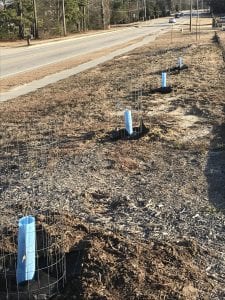
On Saturday, February 2, 2019, Dale, Jet, and Jet’s son Brett planted 4 offspring from a Berry F-1 tree in the area that formerly housed the oak trees.  The soil was soft and the planting holes were easy to dig, which is always nice to experience!  They added blue tubes and cages the day of the planting, and Jet and Brett will place additional mulch around the plantings and secure the cages with landscape brick to prevent them from blowing over.

Jet and the congregation are very appreciative of the seedling donation as well as Dale’s contribution of time and planting expertise. Dale gave Jet the seedling genetic information provided by Martin along with a chestnut brochure to share with interested church members.   Dale will make “seedling check-ups” at the church later in the spring, and will stay in contact with Jet.  Jet and other church members will monitor and water the chestnut seedlings, which so aptly live at the Chestnut Oak Baptist Church now! 
Georgia News Chapter Menu

Georgia Facebook

Comments Box SVG iconsUsed for the like, share, comment, and reaction icons

On Friday March 6 faculty and staff at the University of North Georgia (UNG) added about 70 chestnuts by direct seeding to the Hurricane Creek orchard near Dahlonega. Karrie Ann Fadroski, Outreach and Engagement Coordinator for UNG’s Environmental Leadership Center (ELC) and Stacie James, Program Coordinator for the ELC, were assisted by Dr. Martin Cipollini, President and Science Coordinator for GA-TACF as well as several UNG student volunteers. Student participants included Chestnut student intern Lillian McGinnis, Hurricane Creek student intern Jason Richardson, Conservation student intern Reece Maxwell, Kylee Melton, Ava Minor, Mary Alice Olewicz, and Jack Nicholas.

This orchard is designed to screen hybrid chestnuts for Phytophthora Root Rot (PRR) resistance (pure American chestnuts are entirely susceptible to PRR). Seeds selected for this orchard come from trees known or suspected to carry PRR resistance, in this case from two trees at the Berry College backcross orchard. Read elsewhere on our Facebook page about how to protect chestnuts from this lethal disease if you have planted susceptible trees.

To learn more about this work and what you can do to become involved, please come to our annual meeting on May 2 at the Gwinnett Environmental & Heritage Center in Buford. Details are forthcoming, but the meeting will be held in the morning with lunch and a tour at Cloudland Vineyards in the early afternoon.
The American Chestnut Foundation University of North Georgia Berry College
... See MoreSee Less

On Friday March 6 faculty and staff at the University of North Georgia (UNG) added about 70 chestnuts by direct seeding to the Hurricane Creek orchard near Dahlonega.  Karrie Ann Fadroski, Outreach and Engagement Coordinator for UNG’s Environmental Leadership Center (ELC) and Stacie James, Program Coordinator for the ELC, were assisted by Dr. Martin Cipollini, President and Science Coordinator for GA-TACF as well as several UNG student volunteers.  Student participants included Chestnut student intern Lillian McGinnis, Hurricane Creek student intern Jason Richardson, Conservation student intern Reece Maxwell, Kylee Melton, Ava Minor, Mary Alice Olewicz, and Jack Nicholas.This orchard is designed to screen hybrid chestnuts for Phytophthora Root Rot (PRR) resistance (pure American chestnuts are entirely susceptible to PRR).  Seeds selected for this orchard come from trees known or suspected to carry PRR resistance, in this case from two trees at the Berry College backcross orchard.  Read elsewhere on our Facebook page about how to protect chestnuts from this lethal disease if you have planted susceptible trees.To learn more about this work and what you can do to become involved, please come to our annual meeting on May 2 at the Gwinnett Environmental & Heritage Center in Buford.  Details are forthcoming, but the meeting will be held in the morning with lunch and a tour at Cloudland Vineyards in the early afternoon.The American Chestnut Foundation University of North Georgia Berry CollegeImage attachmentImage attachment+7Image attachment

2 CommentsComment on Facebook

Hard to believe these students are in their late 30s now...

Coincidentally, exactly 17 years ago on March 6, 2009, Berry College students planted the parents of the seeds planted at UNG. Here are just a couple pictures from that day.

Dr. Martin Cipollini, President and Science Coordinator of The Georgia Chapter of The American Chestnut Foundation, presented an overview of the organization's Recurrent Genomic Selection (RGS) chestnut breeding program during the Tennessee chapter's annual meeting at Tennessee Tech, subsequently chairing the Southern Regional Science meeting held in conjunction with the TN-TACF meeting. At the latter meeting, chapter leaders discussed how to cooperate to implement RGS regionally and initiated plans for the coming breeding season. They also welcomed newly hired TACF Regional Science Coordinator Zach Anderson who has been working with Dr. Hill Craddock at the University of Tennessee - Chattanooga. Zach's office will be located in Chattanooga. The American Chestnut Foundation ... See MoreSee Less

Dr. Martin Cipollini, President and Science Coordinator of The Georgia Chapter of The American Chestnut Foundation, presented an overview of the organizations Recurrent Genomic Selection (RGS) chestnut breeding program during the Tennessee chapters annual meeting at Tennessee Tech, subsequently chairing the Southern Regional Science meeting held in conjunction with the TN-TACF meeting. At the latter meeting, chapter leaders discussed how to cooperate to implement RGS regionally and initiated plans for the coming breeding season. They also welcomed newly hired TACF Regional Science Coordinator Zach Anderson who has been working with Dr. Hill Craddock at the University of Tennessee - Chattanooga. Zachs office will be located in Chattanooga.  The American Chestnut Foundation
Load more