Georgia News

Chestnut Wood for Grafting Wanted!

Scionwood for grafting wanted!

Scion wood collection for Southern American chestnut conservation

The American Chestnut Foundation is seeking scion wood from wild American chestnut trees from the southern population. Population studies have determined that trees found in Western TN and KY, GA, AL, and MS represent the southern population and are the most genetically diverse.

The objectives of this collection are to:

  1. Conserve genetic diversity of unique and underrepresented populations of American chestnut through grafting.
  2. Grow these grafted plants in favorable conditions (including growth chambers) to promote flowering and ease of pollen collection.
  3. Future utilization of pollen and flowers to outcross transgenic chestnut.

Goal for 2023: Gather around 100 sources from the south – Gather in January 2023 for grafting in January and February 2023!

Protocol

  • Coordinate with Jamie Van Clief at gro.fca@feilcnav.eimaJ for the collection of this scion wood.
  • Scion wood collection should be done during winter dormancy only, which is commonly marked by the loss of leaves or brown leaves dangling (flagged) on their branches. Ideally, collected between December 2022 – January 2023.
  • It may be necessary to visit sites twice: once, before winter dormancy to ensure species can be identified to the American chestnut, particularly in areas where they co-occur with chinquapin. Second, when trees have gone dormant to collect scion wood.
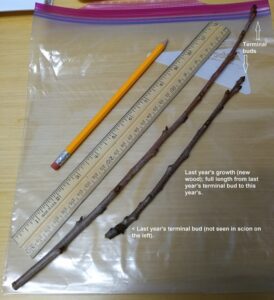
  • Scion wood should be at least 3 inches long and contain 1 or more unopened buds. With nut grafting, the diameter of the scion is not a concern, but larger buds with space in between buds are preferred (see photos below)
  • Collect 10 pieces of scion wood per tree, when possible. At a minimum, we are looking for about 15 buds. However, use judgment when collecting from small trees to not jeopardize the tree’s survival by over-collecting.
  • Take GPS coordinates from each tree using the TreeSnap application for smartphones (https://treesnap.org/) or with a GPS unit or smartphone. Ideally, trees have already been ID’d and entered into TACF’s dentataBase.
  • Place scion wood from a single tree in a one-gallon sealable bag.

• For each tree, place a note card in the bag containing:

  1. Date collected
  2. County
  3. State
  4. Latitude and Longitude
  5. Previously used for breeding or not: Yes, No, or Unknown
  6. TreeSnap ID or wild tree code from Regional Science Coordinator (if applicable)
  7. Public or Private land (do not trespass!)
  • Before sealing, place the card in the bag, then roll the bag from the bottom to the top to remove excess air.
  • Do not write on the bag as even permanent markers will fade or be scratched off during handling and storage. Temporary writing on bags is fine, but do not rely on them for storage.
  • Do not place a damp paper towel in the bag. Moisture from the towel commonly causes mold during storage.
  • If desired place them in damp (NOT WET!) peat moss in the bag. The peat moss should be damp enough that you can squeeze it into a ball but not so damp you can squeeze water out of it. • While in the field, store scion wood in a cooler with cold packs and place it in the refrigerator’s crisper drawer until shipping. Do not place it in the freezer.
  • Please ship scion wood no later than 2-3 weeks after collection. This is a link to a map showing known locations of chestnuts in GA. Note that we are only looking for Castanea dentata (American chestnut) which typically occurs in wild locations (not yard, street, or farm trees).

For GA trees, it is preferable to use the Tree ID Code (e.g., GAFL2) that appears at the top of the bubble when a tree is clicked on the map. https://www.google.com/maps/d/edit?mid=1fdxMnFzo150VtwxvbEF8hipSXcCL9hY&ll=33.75432542157627%2C-84.04990611000001&z=7

Shipping:

  • Ship on Sunday through Wednesday via 2-day shipping to the attention of Chance Parker. Do not ship on Thursday or Friday. Chance Parker, 23332 Success Road, Saucier MS 39574
  • Please send Chance and Jamie the shipping tracking number so everyone knows what’s been shipped. TACF will cover the cost of shipping. They can give you the TACF shipping account numbers.
  • In the memo section of the shipping document, please write “southern scion” so that TACF can track the shipping costs associated with this project.

Contact information:

Ship samples on cold packs and in a small foam cooler, if possible.

Supplies:

  • Sealable gallon freezer bags
  • GPS unit or smartphone with TreeSnap (https://treesnap.org/)
  • Permanent marker for making notes on cards
  • Note cards or paper
  • Pruners hand and/or pole, depending on tree size
  • Cooler and cold packs

Examples of dormant scion wood suitable for grafting purposes (in 1 gal bag).


Georgia News Chapter Menu

Georgia Facebook

Comments Box SVG iconsUsed for the like, share, comment, and reaction icons

On Friday March 6 faculty and staff at the University of North Georgia (UNG) added about 70 chestnuts by direct seeding to the Hurricane Creek orchard near Dahlonega. Karrie Ann Fadroski, Outreach and Engagement Coordinator for UNG’s Environmental Leadership Center (ELC) and Stacie James, Program Coordinator for the ELC, were assisted by Dr. Martin Cipollini, President and Science Coordinator for GA-TACF as well as several UNG student volunteers. Student participants included Chestnut student intern Lillian McGinnis, Hurricane Creek student intern Jason Richardson, Conservation student intern Reece Maxwell, Kylee Melton, Ava Minor, Mary Alice Olewicz, and Jack Nicholas.

This orchard is designed to screen hybrid chestnuts for Phytophthora Root Rot (PRR) resistance (pure American chestnuts are entirely susceptible to PRR). Seeds selected for this orchard come from trees known or suspected to carry PRR resistance, in this case from two trees at the Berry College backcross orchard. Read elsewhere on our Facebook page about how to protect chestnuts from this lethal disease if you have planted susceptible trees.

To learn more about this work and what you can do to become involved, please come to our annual meeting on May 2 at the Gwinnett Environmental & Heritage Center in Buford. Details are forthcoming, but the meeting will be held in the morning with lunch and a tour at Cloudland Vineyards in the early afternoon.
The American Chestnut Foundation University of North Georgia Berry College
... See MoreSee Less

On Friday March 6 faculty and staff at the University of North Georgia (UNG) added about 70 chestnuts by direct seeding to the Hurricane Creek orchard near Dahlonega.  Karrie Ann Fadroski, Outreach and Engagement Coordinator for UNG’s Environmental Leadership Center (ELC) and Stacie James, Program Coordinator for the ELC, were assisted by Dr. Martin Cipollini, President and Science Coordinator for GA-TACF as well as several UNG student volunteers.  Student participants included Chestnut student intern Lillian McGinnis, Hurricane Creek student intern Jason Richardson, Conservation student intern Reece Maxwell, Kylee Melton, Ava Minor, Mary Alice Olewicz, and Jack Nicholas.This orchard is designed to screen hybrid chestnuts for Phytophthora Root Rot (PRR) resistance (pure American chestnuts are entirely susceptible to PRR).  Seeds selected for this orchard come from trees known or suspected to carry PRR resistance, in this case from two trees at the Berry College backcross orchard.  Read elsewhere on our Facebook page about how to protect chestnuts from this lethal disease if you have planted susceptible trees.To learn more about this work and what you can do to become involved, please come to our annual meeting on May 2 at the Gwinnett Environmental & Heritage Center in Buford.  Details are forthcoming, but the meeting will be held in the morning with lunch and a tour at Cloudland Vineyards in the early afternoon.The American Chestnut Foundation University of North Georgia Berry CollegeImage attachmentImage attachment+7Image attachment

2 CommentsComment on Facebook

Hard to believe these students are in their late 30s now...

Coincidentally, exactly 17 years ago on March 6, 2009, Berry College students planted the parents of the seeds planted at UNG. Here are just a couple pictures from that day.

Dr. Martin Cipollini, President and Science Coordinator of The Georgia Chapter of The American Chestnut Foundation, presented an overview of the organization's Recurrent Genomic Selection (RGS) chestnut breeding program during the Tennessee chapter's annual meeting at Tennessee Tech, subsequently chairing the Southern Regional Science meeting held in conjunction with the TN-TACF meeting. At the latter meeting, chapter leaders discussed how to cooperate to implement RGS regionally and initiated plans for the coming breeding season. They also welcomed newly hired TACF Regional Science Coordinator Zach Anderson who has been working with Dr. Hill Craddock at the University of Tennessee - Chattanooga. Zach's office will be located in Chattanooga. The American Chestnut Foundation ... See MoreSee Less

Dr. Martin Cipollini, President and Science Coordinator of The Georgia Chapter of The American Chestnut Foundation, presented an overview of the organizations Recurrent Genomic Selection (RGS) chestnut breeding program during the Tennessee chapters annual meeting at Tennessee Tech, subsequently chairing the Southern Regional Science meeting held in conjunction with the TN-TACF meeting. At the latter meeting, chapter leaders discussed how to cooperate to implement RGS regionally and initiated plans for the coming breeding season. They also welcomed newly hired TACF Regional Science Coordinator Zach Anderson who has been working with Dr. Hill Craddock at the University of Tennessee - Chattanooga. Zachs office will be located in Chattanooga.  The American Chestnut Foundation
Load more