Georgia News

GA-TACF Science Progress 2022

2022 was a very productive year for the Georgia chapter of TACF and its many citizen volunteers.  Here is a quick summary of progress, starting with a summary of what we’ve been able to accomplish in the breeding program since 2006.

Seed type
Crosses
American chestnut C. dentata 123
F1 17
BC1 17
BC2 2
BC3 113
BC4 114
Chinese chestnut C. mollissima 31
Darling 58 (OXO) 7
Other (Quasi B1, C. henryi, C. pumila, etc.) 38
Total 
461
Summary of summer/fall 2022 breeding work:

11 backcross lines for blight resistance screening

4 backcross lines for Phytophthora root rot (PRR) resistance screening

4 backcross lines for both blight and PRR resistance screening

14 C. dentata or nearly 100% C. dentata lines for germplasm conservation

9 Asian lines for phylogenetic study of blight resistance

Total of 1234 seeds produced
Other key activities summer/fall/winter 2023

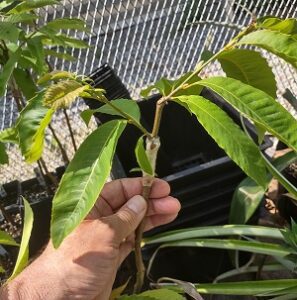
Grafting: Grafted 62 scions of pure C. dentata on C. mollissima root stock.  14 alive from 4 lines.  Also, scion material was sent to USFS for nut grafting (material from about 25 different C. dentata in GA was collected and sent in January 2023)
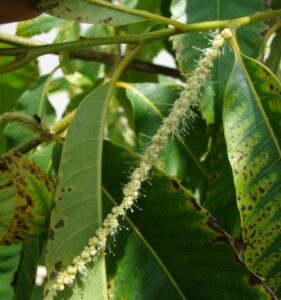
Pollen collection: Pollens collected, processed, and frozen from 27 trees (10 C. dentata, 14 “Best” backcross trees, and 3 F1s).
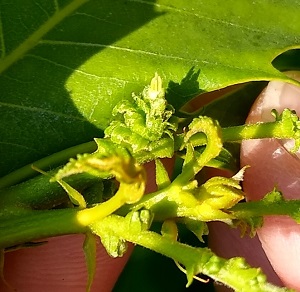
Best X Best crosses: While our Best X Best hand pollinations at UGA largely failed, our GA pollens were successfully used to produce at least seven crosses by the Tennessee chapter (more by Meadowview and CC chapters).
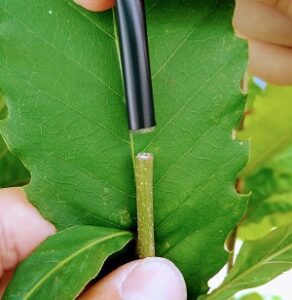
Small stem assays (SSAs): SSAs were completed on ~350 seedlings at Berry College (11 backcross lines plus controls). Small stem assay manuscript was published in Plant Disease (Conn, et al.). This Alternate SSA (AltSSA) method is beginning to be the standard for early blight screening in the TACF program. Winners going to Richards orchard.
Blight evaluations, orchard inoculations, and culling: Done at Roy Richards and Flint backcross seed orchards.
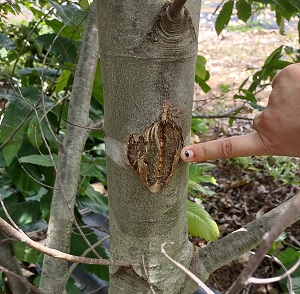
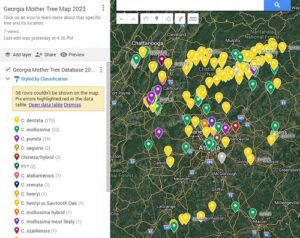
Tree mapping: Several new Castanea trees were catalogued and mapped, including one C. dentata in Oconee County and about 27 new C. dentata from recent TreeSnap observations.  See map here: https://www.google.com/maps/d/edit?mid=1zVPTIqnrXk5PVFMa2Uz4K5kSZ4SRepc&ll=34.0926447786694%2C-83.66902105&z=7
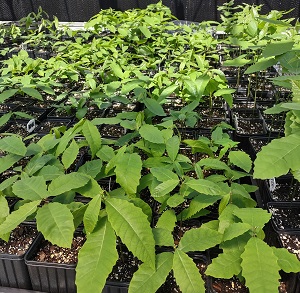
Germplasm conservationC. dentata seedlings from 2021 crop are being distributed to various germplasm conservation orchards for planting winter 2022-23.  Embryos from GA trees were successfully cloned from several sources by the Merkle UGA lab and some lines have been successfully transformed with the OXO gene.
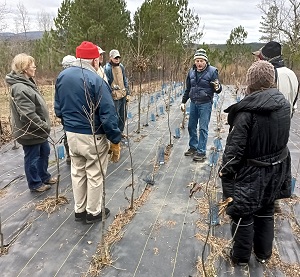
Breeding orchard plantings: Trees were added for PRR screening at Flint North Ridge site in October 2022. Trees are ready for planting at Roy Richards seed orchard in early 2023.
Miscellaneous other:

Phylogenetic study: Seeds from C. mollissima, C. henryi, and C. seguinii were harvested for a collaborative phylogenetic study being organized by Jared Westbrook at TACF.

Tree searching: Testing of protocol is underway for locating new C. dentata using drones (Jack Rogers).

DNA analysis: A few samples of leaves were taken from key trees for DNA analysis.


Georgia News Chapter Menu

Georgia Facebook

Comments Box SVG iconsUsed for the like, share, comment, and reaction icons

On Friday March 6 faculty and staff at the University of North Georgia (UNG) added about 70 chestnuts by direct seeding to the Hurricane Creek orchard near Dahlonega. Karrie Ann Fadroski, Outreach and Engagement Coordinator for UNG’s Environmental Leadership Center (ELC) and Stacie James, Program Coordinator for the ELC, were assisted by Dr. Martin Cipollini, President and Science Coordinator for GA-TACF as well as several UNG student volunteers. Student participants included Chestnut student intern Lillian McGinnis, Hurricane Creek student intern Jason Richardson, Conservation student intern Reece Maxwell, Kylee Melton, Ava Minor, Mary Alice Olewicz, and Jack Nicholas.

This orchard is designed to screen hybrid chestnuts for Phytophthora Root Rot (PRR) resistance (pure American chestnuts are entirely susceptible to PRR). Seeds selected for this orchard come from trees known or suspected to carry PRR resistance, in this case from two trees at the Berry College backcross orchard. Read elsewhere on our Facebook page about how to protect chestnuts from this lethal disease if you have planted susceptible trees.

To learn more about this work and what you can do to become involved, please come to our annual meeting on May 2 at the Gwinnett Environmental & Heritage Center in Buford. Details are forthcoming, but the meeting will be held in the morning with lunch and a tour at Cloudland Vineyards in the early afternoon.
The American Chestnut Foundation University of North Georgia Berry College
... See MoreSee Less

On Friday March 6 faculty and staff at the University of North Georgia (UNG) added about 70 chestnuts by direct seeding to the Hurricane Creek orchard near Dahlonega.  Karrie Ann Fadroski, Outreach and Engagement Coordinator for UNG’s Environmental Leadership Center (ELC) and Stacie James, Program Coordinator for the ELC, were assisted by Dr. Martin Cipollini, President and Science Coordinator for GA-TACF as well as several UNG student volunteers.  Student participants included Chestnut student intern Lillian McGinnis, Hurricane Creek student intern Jason Richardson, Conservation student intern Reece Maxwell, Kylee Melton, Ava Minor, Mary Alice Olewicz, and Jack Nicholas.This orchard is designed to screen hybrid chestnuts for Phytophthora Root Rot (PRR) resistance (pure American chestnuts are entirely susceptible to PRR).  Seeds selected for this orchard come from trees known or suspected to carry PRR resistance, in this case from two trees at the Berry College backcross orchard.  Read elsewhere on our Facebook page about how to protect chestnuts from this lethal disease if you have planted susceptible trees.To learn more about this work and what you can do to become involved, please come to our annual meeting on May 2 at the Gwinnett Environmental & Heritage Center in Buford.  Details are forthcoming, but the meeting will be held in the morning with lunch and a tour at Cloudland Vineyards in the early afternoon.The American Chestnut Foundation University of North Georgia Berry CollegeImage attachmentImage attachment+7Image attachment

2 CommentsComment on Facebook

Hard to believe these students are in their late 30s now...

Coincidentally, exactly 17 years ago on March 6, 2009, Berry College students planted the parents of the seeds planted at UNG. Here are just a couple pictures from that day.

Dr. Martin Cipollini, President and Science Coordinator of The Georgia Chapter of The American Chestnut Foundation, presented an overview of the organization's Recurrent Genomic Selection (RGS) chestnut breeding program during the Tennessee chapter's annual meeting at Tennessee Tech, subsequently chairing the Southern Regional Science meeting held in conjunction with the TN-TACF meeting. At the latter meeting, chapter leaders discussed how to cooperate to implement RGS regionally and initiated plans for the coming breeding season. They also welcomed newly hired TACF Regional Science Coordinator Zach Anderson who has been working with Dr. Hill Craddock at the University of Tennessee - Chattanooga. Zach's office will be located in Chattanooga. The American Chestnut Foundation ... See MoreSee Less

Dr. Martin Cipollini, President and Science Coordinator of The Georgia Chapter of The American Chestnut Foundation, presented an overview of the organizations Recurrent Genomic Selection (RGS) chestnut breeding program during the Tennessee chapters annual meeting at Tennessee Tech, subsequently chairing the Southern Regional Science meeting held in conjunction with the TN-TACF meeting. At the latter meeting, chapter leaders discussed how to cooperate to implement RGS regionally and initiated plans for the coming breeding season. They also welcomed newly hired TACF Regional Science Coordinator Zach Anderson who has been working with Dr. Hill Craddock at the University of Tennessee - Chattanooga. Zachs office will be located in Chattanooga.  The American Chestnut Foundation
Load more