West Virginia News

WV chapter work day at the Clements Tree Nursery in Mason County

The state tree nursery in Mason County, WV has two chestnut orchards.  The older orchard was planted in the mid-1970s from nuts from large, surviving American chestnuts in the mid-Atlantic region.  Nuts from the 1970’s orchard were used to initiate a second orchard in the 1990s.  Seeds from the orchards are collected, stratified and grown for sale to the general public.  While the state tree nursery sells all types of trees (oak, maple, sycamore, redbud…) they always sell out of chestnuts very quickly.  Members and friends of the WV chapter gathered in mid-June in an attempt to improve the younger orchard.  Nine individuals, wielding chain saws, loppers and hand saws, made significant progress over a 5-hour period cutting out dead chestnut stems, removing invading Sumac, multiflora rose and Hawthorn trees.  Piles of debris were scattered all over the orchard and everyone went home tired but feeling a sense of accomplishment.  Those assisting were: Dee and Jeanne Quinn (Raleigh County), Martha Snyder (Jackson County), Robert Sypolt and Darrell Dean (Preston County) and Mark and Mindy Double, Amy Metheny and William MacDonald (Monongalia County).

The nursery superintendent, Jason Huffman, can always use help in the fall collecting chestnuts when they fall.  Jason’s contact information is: vog.vw@namffuH.L.nosaJ if you want to help harvest nuts.
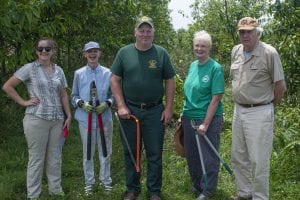
Amy Metheny, Martha Snyder, Jason Huffman (nursery superintendent), Mindy Double and William MacDonald pose for a picture in the orchard.
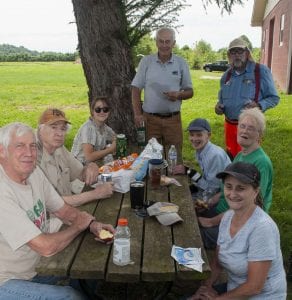
The group takes a lunch break under a Japanese larch. Seated (l to r): Dee Quinn, William MacDonald, Amy Metheny, Martha Snyder, Mindy Double and Jeanne Quinn. Standing are Robert Sypolt and Darrell Dean.
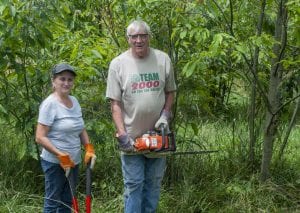
Jeanne and Dee Quinn cut out dead stems from the orchard.
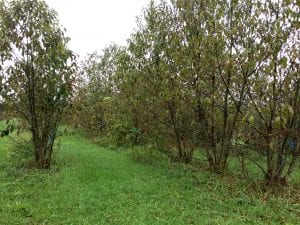
A picture of the orchard prior to removing dead stems and invading species.
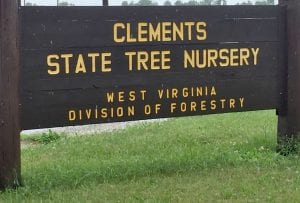
The tree nursery sign on Route 62 along the Ohio River.
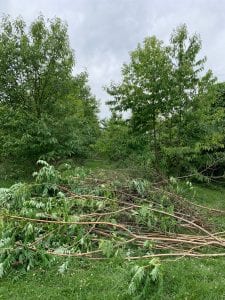
One of many piles of debris.


West Virginia News Chapter Menu

National Facebook

Comments Box SVG iconsUsed for the like, share, comment, and reaction icons

Several chestnut enthusiasts recently had the opportunity to visit John's Creek's planting in Virginia. One of the most memorable sights was the claw marks left by black bears foraging for chestnuts as they prepare for winter, a testament to the planting's success and its growing role in supporting wildlife. The visit took place during this year's NE2333 annual meeting.

#AmericanChestnut #ChestnutRestoration #ForestHealth #WildlifeConservation #HealthyForests
... See MoreSee Less

Several chestnut enthusiasts recently had the opportunity to visit Johns Creeks planting in Virginia. One of the most memorable sights was the claw marks left by black bears foraging for chestnuts as they prepare for winter, a testament to the plantings success and its growing role in supporting wildlife. The visit took place during this years NE2333 annual meeting.#AmericanChestnut #ChestnutRestoration #ForestHealth #WildlifeConservation #HealthyForests

5 CommentsComment on Facebook

Have seen a number of true wild, pure American chestnut trees damaged by black bear. These trees are large enough to survive multiple years of “attacks” by black bear.

Hopefully the damaged bark does not serve as a corridor for the blight to enter living tissue.

Are these engineered trees or crossbred?

View more comments

This excellent article takes a deep dive into the history of the American chestnut, the science driving restoration efforts, and the communities helping make recovery possible. Be sure to read the perspectives shared by TACF Director of Science Jared Westbrook, Board Member Jim Searing, and PA/NJ Chapter member Mike Aucott. 🌳🌰

Read the article: rivertownsmagazine.com/stories/the-return-of-the-american-chestnut-tree,146154

#americanchestnut #forestry #ForestRestoration #citizenscience #Conservation
... See MoreSee Less

This excellent article takes a deep dive into the history of the American chestnut, the science driving restoration efforts, and the communities helping make recovery possible. Be sure to read the perspectives shared by TACF Director of Science Jared Westbrook, Board Member Jim Searing, and PA/NJ Chapter member Mike Aucott. 🌳🌰Read the article: https://rivertownsmagazine.com/stories/the-return-of-the-american-chestnut-tree,146154  #AmericanChestnut #Forestry #ForestRestoration #CitizenScience #Conservation

48 CommentsComment on Facebook

Thanks for sharing! This was a great article and we're glad to be part of the restoration efforts.

I have acreage, but no idea how to purchase these.

I will be pleased if a 100 ft, tall tree with a sweet chestnut can be developed from any of these approaches.

View more comments

The 2026 American Chestnut Symposium is taking shape! The current schedule is live, featuring expert presentations, panel discussions, restoration updates, networking opportunities, and field tours designed to bring our community together around the future of American chestnut restoration

Have research, restoration work, or a project to share? Consider participating in the poster session and connecting with fellow scientists, volunteers, conservation professionals, and chestnut enthusiasts.

Learn more, explore the schedule, and register today at tacf.org/2026-american-chestnut-symposium/

#ForestRestoration #Conservation #forestry #nativespecies #americanchestnut
... See MoreSee Less

The 2026 American Chestnut Symposium is taking shape! The current schedule is live, featuring expert presentations, panel discussions, restoration updates, networking opportunities, and field tours designed to bring our community together around the future of American chestnut restorationHave research, restoration work, or a project to share? Consider participating in the poster session and connecting with fellow scientists, volunteers, conservation professionals, and chestnut enthusiasts.Learn more, explore the schedule, and register today at https://tacf.org/2026-american-chestnut-symposium/ #ForestRestoration #Conservation #Forestry #NativeSpecies #AmericanChestnutImage attachmentImage attachment+2Image attachment

1 CommentComment on Facebook

I will do my best to make it!

What a difference a neighbor can make. 🌳🌳 Our Director of Communications, Jules Smith, recently visited a 10+ year-old hybrid American chestnut covered in burs. Just out of frame is another hybrid chestnut that helped pollinate the tree, resulting in an impressive crop of nuts this year. It's a small but encouraging glimpse of what's possible as we work toward restoring this iconic species. #AmericanChestnut #Trees #Conservation #Nature #RestorationForestry ... See MoreSee Less

12 CommentsComment on Facebook

I heard one of the possible mistakes of the original disease progression of chestnut blight was taking all trees down with signs of blight and not giving trees a chance to demonstrate some resistance. Not sure if that was accurate but it's food for thought as we try to bring them back

So the hybrid trees still get the blight, but can survive it? Rather than just not getting it?

Sorry for the off topic question: I have a 10 year old roughly 4” in diameter that is starting to show signs of blight, in lieu of mud packing I wonder if anyone has painted over it with something waterproof to slow the blight or does the mud do something more than than keep out the oxygen?

View more comments

Load more