By Timothy McKechnie
Since the Connecticut chapter would like to preserve mother trees long enough for breeding purposes, there has been some interest in biocontrol. Most people in TACF, especially Connecticut (home of Dr. Anagnostakis) are familiar with three forms of biocontrol: viral hypovirulence (hypovirulence means “lowered virulence”), genetically engineered hypovirulence, and mudpacking.
Hypovirulence
Using viral (natural) forms of hypovirulence, Dr. Anagnostakis has demonstrated some degree of success with viral (CHV-1) hypovirulence on populations of American chestnut in a forest setting, as measured by more living sprouts per clump and larger stem sizes (Anagnostakis 1990) (Anagnostakis 2001). The orchard plot of mixed hybrids and American chestnuts at Lockwood Farm has also has been a successful use of CHV-1 hypovirulence. The studies by Dr. Anagnostakis are best interpreted on the population level – observing the health of the stand of chestnuts as a whole. Note that there are at least five species of viruses known to infect Cryphonectria parasitica (Hillman and Suzuki 2004), each with different properties. Not all C. parasitica viruses cause hypovirulence or any other known symptom, for example. Michigan strains of viral hypovirulence have been observed to improve American chestnut stands when measured by analysis of life stage distributions (seedling vs sapling vs young tree, etc.) (Davelos and Jarosz 2004).
In practice, biocontrol using hypovirulence depends critically on the use of appropriate vegetative compatibility groups which closely match the compatibility group(s) of the targeted canker(s). Vegetative compatibility group is a genetic character which controls anastomosis, which is the process where two fungal hyphae merge their cytoplasm. Anastomosis is the mechanism of transmittal of most fungal viruses. Once transmitted to a virulent strain, the virus often spreads to the entire canker, a process called conversion. In Connecticut, at least, it’s impossible to know what compatibility group is infecting any given tree without lab tests, so random application of vegetative compatibility groups will most often fail. This problem may be addressed (eventually) by application of hypovirulent strains of every possible vegetative compatibility group (over 120 are known).
Not only does hypovirulence suffer from the problem of matching local compatibility groups, but it can be lots of work. The best application method appears to be direct inoculation in a series of punched or drilled holes around the circumference of each canker. Hypovirulent strain(s) are applied to the holes either as mycelial plugs or as a slurry of conidia and mycelium. Preparing the holes, of course, is labor intensive not to mention dangerous when cankers are high up on a tree. Limited conversion success has been achieved by spraying hypovirulent conidia on cankers (Scibilia and Shain 1989). Sealing the holes with latex caulk after spraying appears to improve conversion efficiency (Scibilia, Hebard et al. 1992).
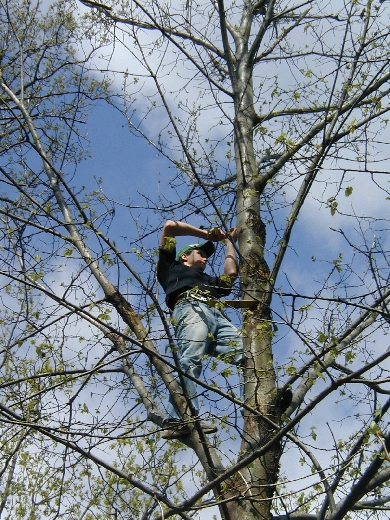 Volunteer Tommy Tamarkin is applying a hypovirus “soup” to treat blight cankers to a Champion American chestnut tree in Barbara Knapp’s Montgomery County.
All things considered, viral hypovirulence is not at present an effective measure to protect individual trees in the eastern USA. What follows is a quote from a recent report by Dr. William MacDonald, (MacDonald and Double 2005), describing his experience in West Virginia, with my comments added in [brackets]. “Procedures first used by Grente [French discoverer of hypovirulence in the 1960s] to treat virulent infections were duplicated. Subsequently, modifications to Grente’s treatment protocols and a variety of different inoculum types were used to introduce hypoviruses into virulent cankers on American chestnut sprouts (Hobbins, Double et al. 1992), (MacDonald and Double 1979). The results often were very encouraging as hypovirus transfer frequently occurred [to the virulent strain that initiated the treated cankers] and the expansion of individual treated infections frequently was arrested as callus tissue formed at the margins of cankers. Even though many of the treatments were successful and the life of sprouts was prolonged, the sheer number of subsequent infections that developed on the same stem dramatically weakened the tree, and when some cankers were not arrested by treatment, trees died (Macdonald and Fulbright 1991). Further, there was little evidence that natural hypovirus spread on the same stem afforded any protection to other virulent infections that almost certainly would arise. With few exceptions, most hypovirulent introductions were unsuccessful if measured by the number of treated sprouts that remained alive several years after treatment (Milgroom and Cortesi 2004).”
Although the story is not over yet, the last statement above unfortunately may soon also apply to the remarkable stand of American chestnuts at West Salem, WI, which has been treated with a variety of hypovirulent strains. It was thought that hypovirulence would work at West Salem stand because there were only a few vegetative compatibility groups present. Treated trees are fairly well protected, but new compatibility groups are appearing, and the disease is quickly spreading to the entire stand. There is evidence that vegetative compatibility groups in Fusarium circinatum, causal agent of pitch canker of pine, may arise by mutation (Wikler and Gordon 2000).
Genetically engineered hypovirulence involves use of C. parasitica strains containing portions of the viral genetic code integrated into the fungal nucleus. Such projects require a permit from the federal government, and so are beyond the reach of the general public. However, the experimental studies in progress are yielding some practical lessons (Root, Balbalian et al. 2005). Brushing engineered conidia onto cankers, with the conidia suspended in an agar slurry or peptone broth, seems to work better than spraying cankers with a water suspension, and does not require punching holes around each canker. Speaking more precisely, however, these comments apply to the process of spermatization, where the applied conidia act to initiate production of sexual spores (ascospores). Spermatization is not limited by vegetative compatibility group. Rather, merely both mating types are required. Like Dr. Anagnostakis’s results, the success observed in these studies is best interpreted on the population level, not on the level of protecting individual trees.
Incidentally, the genetically engineered strains are not spreading very well from inoculated trees to other (non-inoculated) trees nearby, even though plenty of hypovirulent ascospores are being produced, at least in the trials using brush application. This problem might be solved by using a milder form of engineered hypovirulence, and/or by learning more about how ascospores infect trees.
Mudpacking
Mudpacking does work on an individual tree basis, given a tree healthy enough to heal itself and given the procedure is done properly and in time. It’s impossible to be more specific. For fairly obvious reasons, there have been no formal scientific publications on the topic. (Imagine trying to get a scientific grant to study mudpacking!) Vegetative compatibility groups are obviously not a factor with mudpacking.
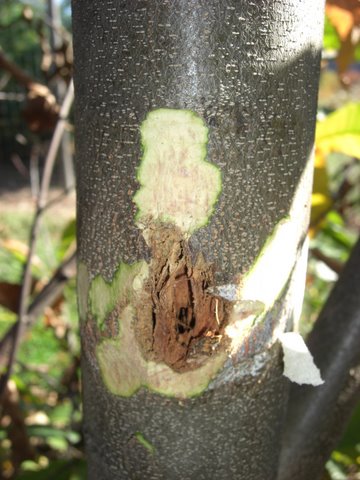 Canker growth can help contain the amount of damage caused by the fungus. The chestnut tree pictured displays good resistance to the blight.
Various methods of mudpacking have been reported. Dr. Fred Hebard prefers to use soil collected from the base of the tree. According to the MA chapter website (http://www.masschestnut.org/mudpackingCankers.html), he moistens the soil enough to make it sticky, then wraps it with 4″ wide “shrink wrap” from a building supplier. I believe shrink wrap is the material used for packing items for shipping. Other people have wrapped trees with burlap bags, duct tape, plastic pipe, coffee cans, etc.. Wrapping mudpacks can be very time-consuming, especially when dealing with a canker near multiple branches. I’ve found that spray painting is far more convenient. Auto body undercoating provides a tough, durable coating in a fraction of the time. Latex paint works nearly as well, and can be applied with a cheap trigger sprayer.
The MA chapter has been using mud fortified with Bacillus megaterium (they call it “Magic Mud”). Apparently this technique works well enough at least some of the time by merely brushing on the wet muddy slurry. Wrapping is apparently not necessary. It’s not clear if anyone has tried merely using plain mud, how often the mud slurry needs to be applied, or what the failure rate is. Dr. Charlotte Zampini will probably have more information to share on this relatively new technique at the CT chapter annual meeting. See also Bio Resistance and Mudpacking.
It’s not clear why mudpacking works, with or without B. megaterium. B. megaterium has been found in association with healing cankers on American chestnuts in Vermont (Groome, Tattar et al. 2001). Patricia Groome’s MS thesis at UMass included experiments designed to detect biocontrol effects of B. megaterium, applied as a water suspension to cankers on American chestnut. She did recover genetically marked strains from cankers a few months after application. However, her experiments did not demonstrate any positive biocontrol effect because the trees were all severely affected by a drought. Many TACF members will remember the association of antagonistic Trichoderma fungus with mudpacking (Tattar, Berman et al. 1996), a line of inquiry which has not been pursued. Because of the nature of bark and soil, which are nearly impossible to sterilize and keep sterile, it’s very difficult to demonstrate antagonism on the tree. So although the bacterium and Trichoderma strains do exhibit antagonism on Petrie plates in the lab, it’s not clear how they work in practice. In pea roots, a strain of Bacillus pumilus was shown to provide biocontrol against Fusarium oxysporum f. sp. Pisi by stimulating plant defense reactions rather than direct antagonism (Benhamou, Kloepper et al. 1996). Strains of Bacillus pumilus, B. polymyxa, Corynebacterium sp. and Klebsiella pneumoniae were shown to produce tannase enzymes when in contact with chestnut bark extract, releasing gallic acid (Deschamps, Otuk et al. 1983), a potent inhibitor of C. parasitica growth. At least one species of Trichoderma used for biocontrol on tobacco has been shown to act by inducing plant defense reactions (Chang, Xu et al. 1997). Conversely, it’s possible that C. parasitica is such a good pathogen of chestnut because it suppresses tree defense reactions (Hebard and Shain 1988).
The way I protect individual trees is to cut out the entire infected area with a hatchet or chisel (no need to use sterile technique) and apply a poultice composed of a sticky combination of dirt, sawdust, and carpenter’s glue. Then I spray paint the poultice with ordinary latex paint. It lasts for a couple of years and is far easier than wrapping fragile, messy mudpacks. Without evidence of any sort, I imagine the best “dirt” is the rich humus from around the base of trees, which ought to be full of bark-decay and/or antagonistic microbes. If the cankers are up too high to work with safely, I just lop off the infected parts, and save as much of the tree as I can. I’ve been doing this with a small grove of Americans in PA for a few years and it works pretty well.
Fungicides
Are there any other options to prolong the flowering stage of mother trees or bring them into production quickly? Readers of the TACF Journal will be familiar with Dr. Terry Tattar’s recent article on use of fungicides, but this is probably not a practical approach for the general public. As far as I know, there is no fungicide approved for use on chestnut – it was necessary for Dr. Tattar to obtain experimental use permits for each fungicide. Also, the Mauget injectors he uses are not available to the general public. I’ve heard of the use of various poultices including eggs and fresh grass extracts. I’ve heard that merely removing cankers with a hatchet works pretty well, without any mudpacking or poultice, but I haven’t tried it. This method is mentioned in the 1912 report of the Pennsylvania Chestnut Blight Commission. Mild soil fertilization may help. Probably any step that improves general tree health, such as removing overstory shade, may serve to prolong the useful life of mother trees. Although it may seem drastic to tree lovers, there is always the option of cutting down the whole tree, burying the stump to kill off the C. parasitica infections, and letting the root system send up fresh sprouts. This method has the advantage of safety, and as far as I know, always works. Given full sun, flowers will be produced near ground level within five or six years, obviating the need for bucket trucks or long ladders. Anyone with experience or ideas is encouraged to share their thoughts.
- Anagnostakis, S. L. (1990). “Improved Chestnut Tree Condition Maintained in Two Connecticut USA Plots after Treatments with Hypovirulent Strains of the Chestnut Blight Fungus.” Forest Science 36(1): 113-124.
- Anagnostakis, S.-L. (2001). “American chestnut sprout survival with biological control of the chestnut-blight fungus population.” Forest Ecology and Management 152(1-3): 225-233.
- Benhamou, N., J. W. Kloepper, et al. (1996). “Induction of defense-related ultrastructural modifications in pea root tissues inoculated with endophytic bacteria.” Plant Physiology 112(3): 919-929.
- Chang, P.-F.-L., Y. Xu, et al. (1997). “Induction of pathogen resistance and pathogenesis-related genes in tobacco by a heat-stable Trichoderma mycelial extract and plant signal messengers.” Physiologia Plantarum.
- Davelos, A. L. and A. M. Jarosz (2004). “Demography of American chestnut populations: effects of a pathogen and a hyperparasite.” Journal of Ecology 92(4): 675.
- Deschamps, A. M., G. Otuk, et al. (1983). “Production of Tannase and Degradation of Chestnut Tannin by Bacteria.” Journal of Fermentation Technology.
- Groome, P. C., T. A. Tattar, et al. (2001). “Bacteria found on American chestnut bark and their potential in biocontrol of chestnut blight.” Arboricultural Journal 25(3): 221-234.
- Hebard, F. V. and L. Shain (1988). “Effects of Virulent and Hypovirulent Endothia-Parasitica and Their Metabolites on Ethylene Production by Bark of American and Chinese Chestnut and Scarlet Oak.” Phytopathology 78(6): 841-845.
- Hillman, B. I. and N. Suzuki (2004). Viruses of the chestnut blight fungus, Cryphonectria parasitica. Advances in Virus Research, Vol. 63. 63: 423.
- Hobbins, D. L., M. L. Double, et al. (1992). Interactions between artificially established virulent Cryphonectria parasitica cankers and sources of virulent and hypovirulent inoculum on American chestnut stems. Proceedings of the International Chestnut Conference, West Virginia University Press.
- MacDonald, W. and M. Double (2005). Hypovirulence: Use and limitations as a chestnut blight biological control. Proceedings of conference on restoration of American chestnut to forest lands, http://chestnut.cas.psu.edu/nps.htm.
- MacDonald, W. and M. L. Double (1979). Effectiveness of slurry treatments in controlling individual Endothia parasitica cankers on American chestnut. USDA General Technical Report NE-64. H. Smith.
- Macdonald, W. L. and D. W. Fulbright (1991). “Biological-Control of Chestnut Blight – Use and Limitations of Transmissible Hypovirulence.” Plant Disease 75(7): 656-661.
- Milgroom, M. G. and P. Cortesi (2004). “Biological control of chestnut blight with hypovirulence: A critical analysis.” Annual Review of Phytopathology 42: 311.
- Root, C., C. Balbalian, et al. (2005). “Multi-seasonal field release and spermatization trials of transgenic hypovirulent strains of Cryphonectria parasitica containing cDNA copies of hypovirus CHV1-EP713.” Forest Pathology 35(4): 277-297.
- Scibilia, K. L., F. V. Hebard, et al. (1992). “Conidia of hypovirulent strains of Cryphonectria parasitica differ in their potential for biocontrol of chestnut blight.” Canadian Journal of Forest Research 22(9): 1338-1342.
- Scibilia, K. L. and L. Shain (1989). “Protection of American Chestnut with Hypovirulent Conidia of Cryphonectria-Parasitica.” Plant Disease 73(10): 840-843.
- Tattar, T. A., P. M. Berman, et al. (1996). “Biocontrol of the chestnut blight fungus Cryphonectria parasitica.” Arboricultural Journal 20(4): 449-469.
- Wikler, K. and T. Gordon (2000). “An initial assessment of genetic relationships among populations of Fusarium circinatum in different parts of the world.” Canadian Journal of Botany-Revue Canadienne De Botanique 78(6): 709-717.