

A New Leaf: Our Newsletters
If you would like to subscribe to receive our periodic e-mail newsletters, please enter your email in the side bar on the right hand-side.
Latest Newsletters
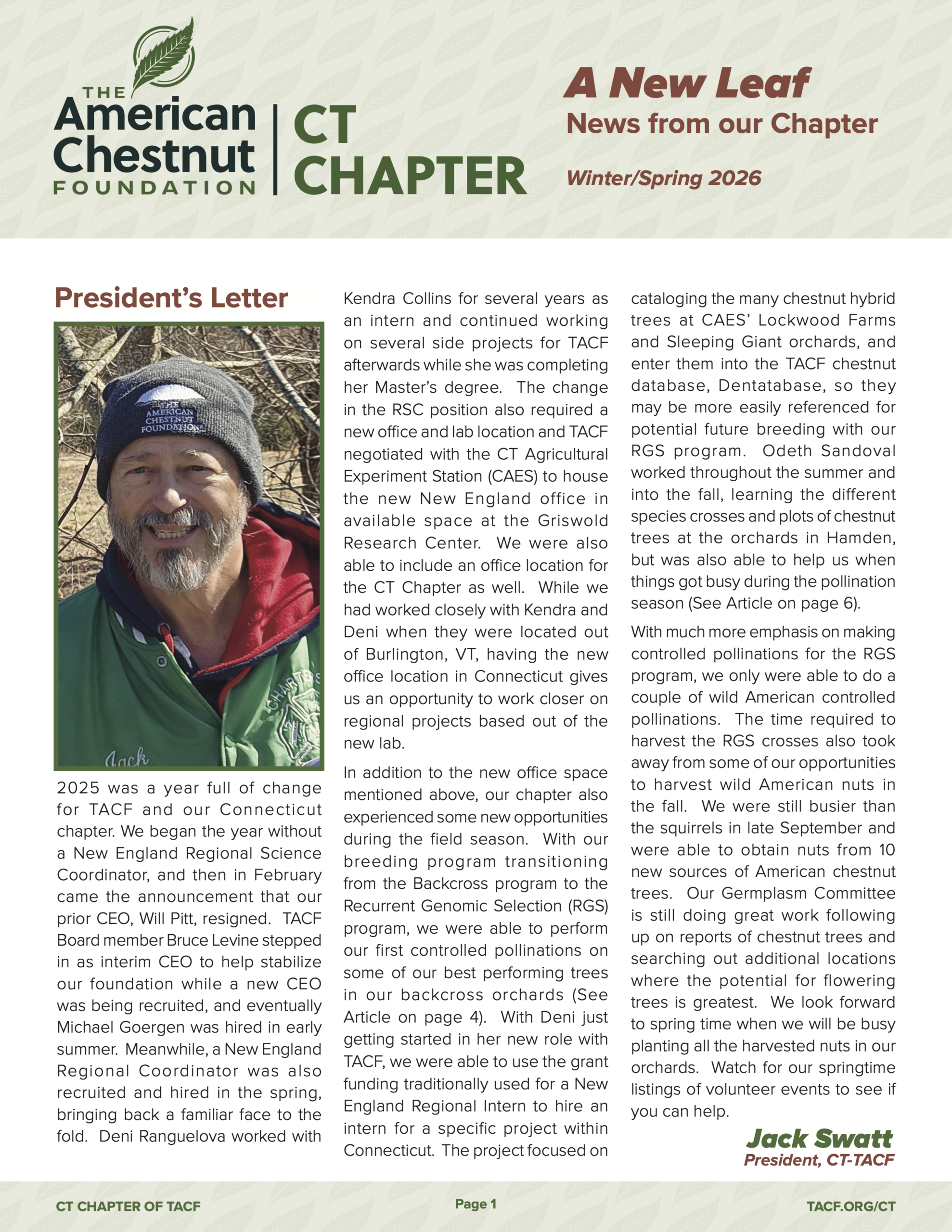
The Connecticut Chapter Spring Newsletter 2026 features a brand new look, matching TACF new branding, and includes the articles:
- Welcome to… the Chestnut City!
- Essex Land Trust & Chestnut Orchard at Cross Lots Preserve
- Chestnut Breeding Program Update
- A Lifelong Passion for The American Chestnut
- CT Chapter’s 2025 Intern, Odeth Sandoval
- TACF Honors the Winners of the 2025 Volunteer Service Awards
- Volunteer Opportunities

The Connecticut Chapter Spring 2025 Newsletter includes the articles
- Celebrating the 40 years of TACF in Hamden
- Backcross Breeding Program Update
- Planting Chestnuts in a Colonial Setting
- Breeding Phytophthera cinamoni Resistance into our Chestnut Orchards
- Volunteer Opportunities
- And Charlie, the rowing chestnut!
Newsletters Archive
- CT-TACF Spring 2024 Newsletter
- CT-TACF Spring 2023 Newsletter
- CT-TACF Spring 2022 Newsletter
- CT-TACF Spring 2021 Newsletter
- CT-TACF Spring 2020 Newsletter
- CT-TACF Spring 2018 Newsletter
- CT-TACF Spring 2009 Newsletter
- CT-TACF Spring 2008 Newsletter
- CT-TACF Autumn 2006 Newsletter
- CT-TACF Spring 2006 Newsletter
- CT-TACF Autumn 2005 Newsletter
Connecticut Chapter Menu
National Facebook

"American chestnut trees were wiped out more than a century ago. Now, new trees that are fungus-resistant are being planted at the zoo."
Read this article by the New York Times about a chestnut tree planting today at the Bronx Zoo, where chestnut blight was first discovered.
Click the following link to read the article: www.nytimes.com/2026/10/05/nyregion/chestnut-trees-bronx-zoo.html?unlocked_article_code=1.GVE.LAU...
#news #americanchestnut #explore #NY #forestry

46 CommentsComment on Facebook
We had a chestnut tree in the yard of an air bnb in Washington's Crossing, PA.
They are hybrid trees, not full American.
Utter waste of time. They’ll be dead from the blight in 50 years just like all true Anerican chestnut trees. These scientists are creating hybrids because they cannot stop the blight.
We're grateful to see the important work of American chestnut restoration highlighted by Wild Appalachia.
The segment features WV Chapter member Mark Double and TACF partner Dr. Amy Metheny of WVU, who share why restoring this iconic native tree matters and the progress being made in West Virginia and beyond.
Watch the whole video or read the article here: wchstv.com/community/wild-appalachia/wild-appalachia-american-chestnut-restoration
3 CommentsComment on Facebook
my daughter in mt pleasant ny ( catskills) has a huge american chestnut tree in front of her 1904 home. somehow it missed the blight
I just sent this as email to Governor Morrisey in West Virginia. Please do the same and send to everyone and anyone who may be able to help in an effort to save Clements Nursery American Chestnut Grove. "Dear Governor Morrisey. I have learned that a private corporation plans to destroy the grove of American Chestnut trees at Clements Nursery. For the love of god and all that is good in this world please help to preserve these American Chestnut trees. There are not that many genuine American Chestnut trees that are still growing and what you have there in West Virginia is a national treasure that cannot be replaced with any amount of money, gold or riches. I among with many other multi generational Americans believe this grove of trees should be a treasured working national historic landmark producing seeds and seedling for reestablishing genuine pure American Chestnut trees in our Appalachian Mountains and throughout our country."
They are planning to destroy the site on Nov. 1, 2026 for a data center 🙁
Georgia folks, don’t forget to mark your calendars for the Chestnutoberfest happening on October 17th! #Georgia
This content isn't available right now
When this happens, it's usually because the owner only shared it with a small group of people, changed who can see it or it's been deleted.0 CommentsComment on Facebook
October is packed with opportunities to support American chestnut restoration! Join us in shucking chestnuts for open-fire roasting this winter and next spring’s plantings, or celebrate at an American Chestnut Festival near you. Don’t see an event hosted by your Chapter? Reach out to learn how you can help during the busy harvest season.
Need more information about an event? Visit: tacf.org/events/category/tacf/
3 CommentsComment on Facebook
I just sent this as email to Governor Morrisey in West Virginia. Please do the same and send to everyone and anyone who may be able to help in an effort to save Clements Nursery American Chestnut Grove. "Dear Governor Morrisey. I have learned that a private corporation plans to destroy the grove of American Chestnut trees at Clements Nursery. For the love of god and all that is good in this world please help to preserve these American Chestnut trees. There are not that many genuine American Chestnut trees that are still growing and what you have there in West Virginia is a national treasure that cannot be replaced with any amount of money, gold or riches. I among with many other multi generational Americans believe this grove of trees should be a treasured working national historic landmark producing seeds and seedling for reestablishing genuine pure American Chestnut trees in our Appalachian Mountains and throughout our country."
And just FYI, Umit Sedar, OMU (university) in Turkey got a lot of seed from Lockwood for their breeding program. Yes, I will join the zoom meeting on the 9th. Sandy
Why aren't you folks screaming about the Clements Tree Farm destruction? 2/3 for a data center??? The destruction is supposed to be underway Nov 1st! What are the arborists doing to at least save whats on those 100 acres? Why isn't this in your newsletter and website?