Connecticut news

Development of Nut Plains Park Orchard

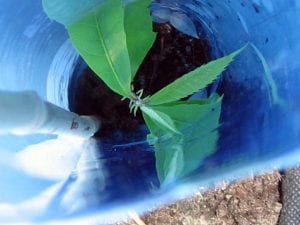
guilford_newA view of a beautiful new American chestnut seedling emerging from its nut as viewed down a Bluex Tree Tube Shelter. Photographer Leila Pinchot [click on photo to see larger version]
A group of dedicated individuals, representing the American Chestnut Foundation and the Guilford Conservation commission, gathered on behalf of the American Chestnut on Saturday, May 5th 2007 at Nut Plains Park. The group planted a test orchard, consisting of twenty hybrid chestnuts, to determine whether the site is suitable for a full orchard.
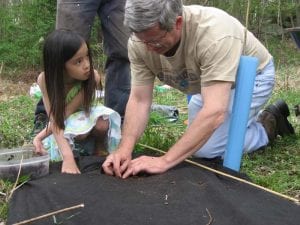
 

CT-TACF Member Brian Pistolese demonstrates nut planting technique. Photographer Leila Pinchot

CT-TACF Member Brian Pistolese demonstrates nut planting technique. Photographer Leila Pinchot

On arrival, the participants found the parcel to have been lying fallow ever since the previous tenants, community gardeners, abandoned the property due to vandalism a few years ago. On the north end of the field, a line running NW to SE 120’ long by 6’ wide was cleared and mowed. Landscaping fabric was laid down with staples and twenty evenly spaced holes were dug and filled with a mixture of peat moss, water, and forest soil containing beneficial mychorrizae. A hybrid chestnut was carefully planted in each hole and protected from voles and deer with a tree shelter. Finally, a clothespin was fastened on each to keep out gobblin’ turkey. If the seedlings grow well, a complete breeding orchard, with about 300 trees, will be established on the site next spring.


Connecticut news Chapter Menu

National Facebook

Comments Box SVG iconsUsed for the like, share, comment, and reaction icons

Lesesne State Forest is 422 acres, and lies next to Three Ridges Wilderness Area in Nelson County, VA. TACF and VA Department of Forestry partner in managing and breeding chestnuts here for restoration. TACF hosted our partners and national board members on a tour of the orchard in mid-November. ... See MoreSee Less

2 CommentsComment on Facebook

Going here for the first time, seeing all the big American Chestnuts and also watching Bill Deeter 's videos and pictures of his trees convinced me that it is possible to breed resistance into American chestnuts! We got this folks

Cool. I planted 56 Dunstan chestnuts on Nov. 3 in damp peat moss. I have to transfer to potting soil soon, they're all sprouting. And I mean it looks like every single nut has germinated.

We’re on the Naturally Scott Podcast!
Our President & CEO sat down with Scott to talk about the past, present, and future of the American chestnut — from its historic role in Appalachia to the cutting-edge science driving restoration today.

- Why the roots never died
- The cutting-edge science behind restoration
- Why volunteers and donors are leading this effort

Watch the full episode now and join us in bringing back America’s iconic tree:

www.youtube.com/@NaturallyScott

podcasts.apple.com/us/podcast/naturallyscott/id1830513032
... See MoreSee Less

We’re on the Naturally Scott Podcast!
Our President & CEO sat down with Scott to talk about the past, present, and future of the American chestnut — from its historic role in Appalachia to the cutting-edge science driving restoration today.

- Why the roots never died
- The cutting-edge science behind restoration
- Why volunteers and donors are leading this effort

Watch the full episode now and join us in bringing back America’s iconic tree:

www.youtube.com/@NaturallyScott

podcasts.apple.com/us/podcast/naturallyscott/id1830513032
... See MoreSee Less

🐛 Large silk moth caterpillar native to North America, not a threatened species fairly common *but beautiful.
🌳 Tree is a wild American chestnut planted for a PRR fungicide trial in Clemson, SC.

Photo credit: Celeste Giles, Research Associate with the Plant and Environment Sciences Department at Clemson
#americanchestnut #explore #nature #bugs #chestnuts #caterpillar
... See MoreSee Less

🐛 Large silk moth caterpillar native to North America, not a threatened species fairly common *but beautiful.🌳 Tree is a wild American chestnut planted for a PRR fungicide trial in Clemson, SC.Photo credit: Celeste Giles, Research Associate with the Plant and Environment Sciences Department at Clemson #americanchestnut #explore #nature #bugs #chestnuts #caterpillarImage attachmentImage attachment

3 CommentsComment on Facebook

Can you tell us more about the PRR fungicide trial?

So cool. Curious if the funguscide harms the catepillar and insects?

Speaking of threat, our local university has discovered the chestnut weevil is not extinct as was thought. www.actionnews5.com/2025/12/08/uofm-researchers-rediscover-weevil-believed-be-extinct-thanks-phot...

In celebration of GivingTuesday, TACF’s Board of Directors and President & CEO Michael Goergen came together to issue a matching gift challenge. The original goal was $5,000, but because of their collective passion and generosity a total of $18,125 has been raised, making the impact of your gift even greater. If that amount is reached, it will double to $36,250! Visit the link in our bio to donate. ... See MoreSee Less

In celebration of GivingTuesday, TACF’s Board of Directors and President & CEO Michael Goergen came together to issue a matching gift challenge. The original goal was $5,000, but because of their collective passion and generosity a total of $18,125 has been raised, making the impact of your gift even greater. If that amount is reached, it will double to $36,250! Visit the link in our bio to donate.
Load more

Subscribe to the CT Chapter Newsletter

* indicates required