What is a TACF Seed Orchard?
A TACF seed orchard represents one of the final generations of breeding in TACF’s current breeding program. It’s the next step for the offspring of resistant trees identified in the Chapter’s Backcross Breeding Orchards.
The Connecticut Chapter of the American Chestnut Foundation (CT-TACF) was established in 1995 and has worked with TACF’s breeding program for regional adaptability since 2005. During that time the Chapter has identified and incorporated over 20 different native American chestnuts from Connecticut into the breeding program and establishing several breeding orchards. The current breeding goals of CT-TACF include installing several seed orchards, where putatively blight-resistant Connecticut-bred chestnuts will be produced. CT-TACF is evaluating sites, and looking to identify partners that can assure long-term sites and support for these seed orchards.
The orchard should be installed on a chestnut-appropriate site, which is also relatively accessible to workers and volunteers. A seed orchard is a long-term project and should be expected to remain on the site for 30-45 years. In full operation six to eight years into its existence, a seed orchard would have twenty maturing if not yet fully grown American chestnut trees, that show signs of blight resistance, having acquired genes for resistance from both parents. They would have plenty of room to grow quickly as each would have about 40 feet square in which to spread. This was considered the optimal production spacing for Chinese chestnuts, where there is significant data on its use in orchards. Each of these chestnuts would have started out as a planting in a plot of some 150 trees (5 rows of 30 trees) with only one of them selected as the “best” example for breeding future generations. The seed orchard would have 20 plots, therefore the 20 trees remaining in the seed orchard after culling the 2980 that weren’t the “best” of their generation.
In the illustration of a seed orchard below, each letter represents a plot of 150 trees when initially planted. These trees come from one of the seven seed orchards located throughout Connecticut. The details of each plot are shown in Illustration 2 further down the page. Plots basically run up against each other and allow enough room between and alongside the fence to operate equipment. Eventually all but one of the trees in each plot are removed, and there remains plenty of room to operate, and for the remaining tree to grow stress-free and quickly, and produce significant quantities of fruit for reforestation purposes.
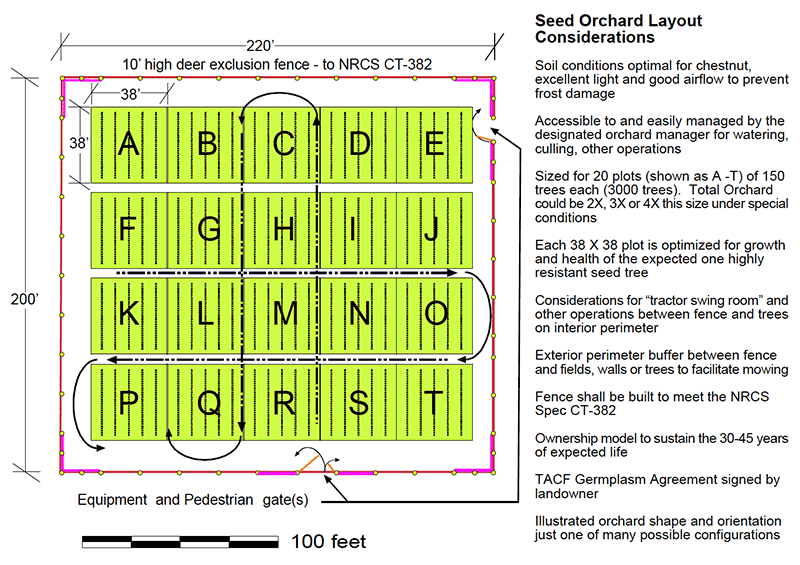
Illustration 1 – Possible Seed orchard Configuration
The TACF breeding program requires each state chapter to produce at least 20 distinct breeding lines within a given source of blight-resistance. These lines are produced by crossing advanced trees from the TACF Meadowview Research Farms with wild American chestnuts native to Connecticut. The resulting offspring are planted, grown to an appropriate size, and challenged with chestnut blight. Trees that exhibit the most blight-resistance and American chestnut character are selected for further breeding and the resulting nuts are then planted in a seed orchard.
A seed orchard planting will be at least one acre, which consists of one block. Each block of seed orchard contains 20 plots, each one representing a different American chestnut parent from CT. Within each plot, 150 trees are planted on tight spacing (Figure 2). With 20 of these plots, at least 3,000 nuts will be planted in a block over the duration of the planting phase of the orchard. Once all the trees in a given plot are about five years old, they will be challenged with the blight fungus. The best tree in each plot will be selected for breeding within the seed orchard, all others will be removed. This means that of the 3,000 nuts planted in a block, only 20 trees will remain after challenging with the blight fungus and making breeding selections. This process will take at least 10 years and, once completed, the orchard will be used for nut production to facilitate forest testing and reintroduction.
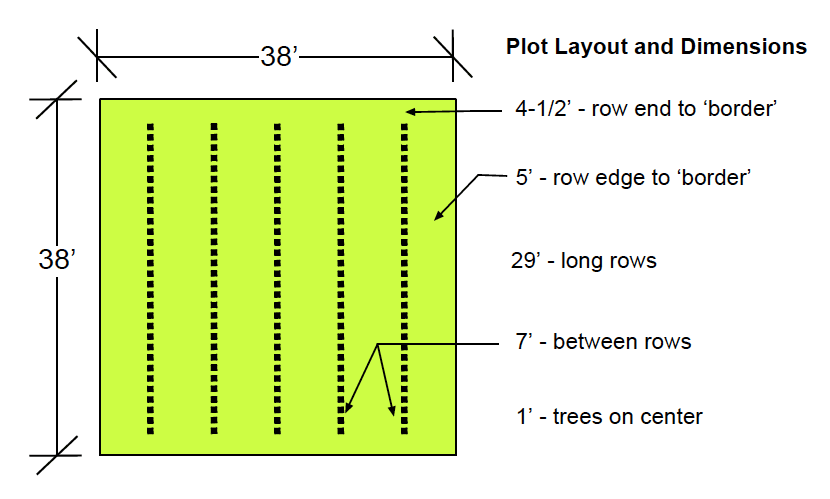
Illustration 2 – Recommended Seed Orchard Plot
Seed Orchard Site Requirements
The main considerations for a seed orchard site are that the site is appropriate for growing American chestnut, accessible for equipment needed to install and maintain the orchard, secure for the expected duration of the planting and has a committed orchard manager with a plan for succession or changes in management.
- American Chestnut Site ConditionsWell-drained, slightly acidic soil (pH 4.5- 6)
- Full sun
Turf or recently cleared forest site
- Full sun
- Seed Orchard-specific Site Conditions
- Site should be at least 1-acre, larger sites could be considered as well
- Accessible by large equipment for plowing/soil prep, mowing and rogueing (removing unselected trees); possibly by a bucket truck
- Accessible by orchard manager and other volunteers for planting and regular maintenance and upkeep
- Some way to get water on the site (creative solutions are welcome)
- Deer fencing will be required in most cases
- Security of the Site
- A seed orchard is expected to be a 30-45-year project and the site needs to be secure and
dedicated to that use for the duration of the planting’s use - A TACF Germplasm Agreement must be signed by the landowner
- A long-term agreement between TACF and the host will be developed that outlines the responsibilities of both parties. A lease agreement could also be considered.
- A seed orchard is expected to be a 30-45-year project and the site needs to be secure and
- Orchard Management
-
- Visit the site regularly and report any problems or issues as they arise
- Keep up with regular maintenance- vegetation control (mowing, weeding), fertilization, irrigation and yearly inventories
- Work closely with the TACF Staff and volunteers to plan planting, inoculation, selection and rogueing activitiesThe orchard manager is the point contact between TACF and the seed orchard site. It is expected that the orchard manager will:
- It is expected that the orchard manager will change over the course of the project and a plan for passing down management responsibilities should be formulated
-
Other Reading
A two-page printable (and distributable) version of this page.
A sample seed orchard agreement
A sample Orchard Management Plan
An article from the Journal of the American Chestnut Foundation.