Georgia News

Dawson Forest American Chestnut Project

In April of 2018 the Georgia Department of Natural Resources, along with the American Chestnut Foundation, broke ground on a project that has been years in the making. Two small crews lead by Nathan Weaver, the GADNR forester for north Georgia, planted approximately 2,500 American chestnut B3F3 hybrid seedlings at Dawson Forest Wildlife Management Area. Volunteers from within GADNR, the public, The Nature Conservancy, and Wildland Restoration International Assisted with the project.  Bare root seedlings were provided by state nurseries in West Virginia and Kentucky.
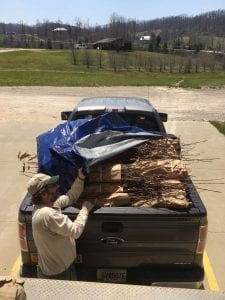
Hybrid seedlings loaded up just before being covered with ice and tarps for the trip to their new home in Georgia.

The plantings will be part of a long-term research project on fire tolerance and silvicultural viability of the chestnut hybrids. The project is a collaboration between GADNR, Berry College, and The American Chestnut Foundation. The goal is for the Georgia Department of Natural Resources to provide technical guidance on wildland plantings of the hybrids to Georgia landowners. Traditional orchard planting may not be cost effective for some landowners who want the species established on their property, as there may be no power for electrical fencing and it can be expensive or impractical to use traditional nursery techniques like mowing and tubes. We want to demonstrate an economically viable process for a landowner who is interested in conservation, as well as timber revenue. Pine tree value has proven to be somewhat volatile in north Georgia, while hardwood markets have remained consistent and strong over the past few decades. In north Georgia hardwood is and likely will remain higher in market value.
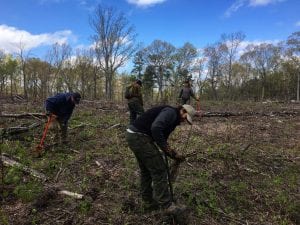
Volunteers Jen Houts (The Nature Conservancy), Ryan Kennelly, Joey Bell, and Ethan Daley (Wildland Restoration International) planting seedlings at Dawson Forest WMA.

The second piece of the study will involve learning about the fire tolerance of the hybrids. It is presumed that it is a fire tolerant species, and some recent work by other groups is confirming this. Our goal is to produce recommendations for landowners on how long to wait before performing the first prescribed burn to ensure maximum survival. Each block will be broken into 4 sub-units, that will be burned after three years, six years, eight years, or not at all. We are interested in seeing if the hybrids can be managed in conjunction with shortleaf pine, as the two species prefer dryer and rockier soil.

About 3 months after planting we are seeing 80-85% survival of seedlings, with little to no evidence of browse from deer (*knocks on wood*). Some insect herbivory has occurred. We will continue to monitor the trees, keeping track of survival rates.
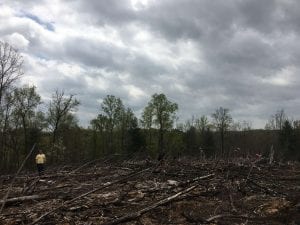
Volunteers Cody Venters, Kiki Dehondt, Jen Houts (TNC), and Nick Batt planting trees at Dawson Forest WMA.


 

Georgia News Chapter Menu

Georgia Facebook

Comments Box SVG iconsUsed for the like, share, comment, and reaction icons

Did you know that private landowners - even homeowners with a big backyard - can help support GA-TACF by planting trees on our behalf? Here are just two examples, one a two year old tree planted in Paul Burks' backyard in Atlanta and one a 6 year old tree planted in Scott Frazier's Bottomlands orchard near Taylorsville. Looking good guys!

Read more about planting trees with us here: tacf.org/ga-news/so-you-want-to-plant-some-chestnuts/

The American Chestnut Foundation
Berry College
... See MoreSee Less

Did you know that private landowners - even homeowners with a big backyard - can help support GA-TACF by planting trees on our behalf? Here are just two examples, one a two year old tree planted in Paul Burks backyard in Atlanta and one a 6 year old tree planted in Scott Fraziers Bottomlands orchard near Taylorsville. Looking good guys!Read more about planting trees with us here: https://tacf.org/ga-news/so-you-want-to-plant-some-chestnuts/The American Chestnut Foundation Berry CollegeImage attachment

2 CommentsComment on Facebook

Beautiful form on that second tree

I have room to plant American Chestnut trees! I would definitely plant them, just tell me how to get them.

We want to thank all of the volunteers who helped us this pollination season which is now complete! We were able to bag and pollinate 10 different trees (a record for or us) plus we collected pollen from a number of other trees. This work is crucial for our Best X Best (or RGS) chestnut disease resistance breeding program. Altogether, over the past three weeks, we have had 20 different volunteers plus several more who volunteered but had their shifts cancelled due to weather. We thank all of you! GA-TACF is an all-volunteer organization except for a few interns that are obligated to certain orchard sites (Flint, Hurricane Creek).

Our next major volunteer efforts will start in mid-September when we will harvest and shuck burs and tabulate our harvest. Please stay tuned for announcements about these opportunities! Click here to register to volunteer with us or to sign the volunteer waiver form if you have not already done so: theamericanchestnutfoundation.volunteerlocal.com/volunteer/?id=99170

Here are a few more photos of our final two days when we were assisted by Berry College students who are working in Dr. Adrienne Ernst's lab this summer.

The American Chestnut Foundation
Berry College
... See MoreSee Less

We want to thank all of the volunteers who helped us this pollination season which is now complete!  We were able to bag and pollinate 10 different trees (a record for or us) plus we collected pollen from a number of other trees.  This work is crucial for our Best X Best (or RGS) chestnut disease resistance breeding program.  Altogether, over the past three weeks, we have had 20 different volunteers plus several more who volunteered but had their shifts cancelled due to weather.  We thank all of you!  GA-TACF is an all-volunteer organization except for a few interns that are obligated to certain orchard sites (Flint, Hurricane Creek).  Our next major volunteer efforts will start in mid-September when we will harvest and shuck burs and tabulate our harvest.  Please stay tuned for announcements about these opportunities! Click here to register to volunteer with us or to sign the volunteer waiver form if you have not already done so: https://theamericanchestnutfoundation.volunteerlocal.com/volunteer/?id=99170Here are a few more photos of our final two days when we were assisted by Berry College students who are working in Dr. Adrienne Ernsts lab this summer.The American Chestnut FoundationBerry CollegeImage attachmentImage attachment+3Image attachment

1 CommentComment on Facebook

Great photos...wish I were there to help with this....I got experience operating one of those boon lifts last year!

Here is a short YouTube video showing how we process catkins and store pollen for chestnut breeding purposes. Pollens processed like this are being used in this summer's Best X Best breeding program.

We are still looking for assistance from chapter volunteers for this program!

Volunteers need not have experience; essential safety and pollination training will be provided at the start of each shift. Our next dates will be Tuesday June 9 and Wednesday June 10 (9 am - noon, and 1 - 5 pm shifts). We can only pollinate when it is not raining, but despite the chance of rain on those days we need to make an attempt at it. Our fallback "rain delay" date will be Thursday June 11. Harvest will take place in September and October when we again will need volunteer help.

If you have not already registered to volunteer with GA-TACF, please do so here: theamericanchestnutfoundation.volunteerlocal.com/volunteer/?id=99170

After you have registered, please sign up for pollination shifts here: theamericanchestnutfoundation.volunteerlocal.com/volunteer/?id=113887

I hope you will be able to help!

The American Chestnut Foundation Berry College
... See MoreSee Less

Video image

1 CommentComment on Facebook

Great video, Martin! Interesting and informative!

Load more