Georgia News

GA-TACF work during the Spring 2020 COVID-19 crisis

GA-TACF members and collaborators:

I know it has been a while since we’ve touched base with you, and I hope this message finds you healthy and secure.  I wanted to let you know that the Georgia chapter’s work has continued this spring, despite the need to avoid calling on large groups of volunteers.  Below, I have listed a summary of some of the work that has been going on, almost all of which has been done by the volunteer stewards at the indicated locations (the principle leaders are listed).

We hope to get back to some safe-distance work with volunteer groups this summer, primarily in helping conduct blight-resistance tests in several orchards.  I have included a photo gallery showing some images from this spring’s work.  If you have done (or know of) significant recent GA-TACF work that we are unaware of, please let us know!  You can contact us easiest at moc.liamg@tuntsehcag.

At some point soon, chapter president Kathy Patrick plans to call a brief on-line membership meeting using Zoom. The main order of business will be to thank members who are rotating off the board (Lynn Womack, Nathan Klaus, and Jimmy Rickard), and to elect three new board members.  Details will be forthcoming soon as to how this meeting will be conducted.

Martin Cipollini, GA-TACF Science Coordinator

Demo/educational orchard plantings:

Briarlake Forest and Chestnut Grove Church – Dale Higdon (~18 seedlings total)

Sandy Creek Nature Center – Michael Wharton and Ben Jarrett (~70 seedlings)

Sloppy Floyd State Park – Elaine Thomas, David Norboge, and Robert Helton (~18 seedlings)

Charlane Plantation – Chuck Leavell (12 seedlings)

Turnip Mountain – Billy Nicholson (6 seedlings)

Cipollini GA property – Martin Cipollini (4 seedlings)

Cipollini PA property – Don Cipollini, Sr. (5 seedlings)

Krissman property – Paul Krissman (2 seedlings)

Research orchard plantings:

Flint Phytophthora screening orchard – Austin Flint, John French, and Zach Felix (~150 seedlings)

Bottomlands Phytophthora screening planting – Scott Frazier (~38 seedlings)

Roy Richards seed orchard – Kris Owens (site preparation work)

(>320 seedlings planted to demo and research orchard sites combined)

Ambrosia beetle and Phytophthora root rot spraying and mitigation work:

Berry College and Henry backcross orchards – Martin Cipollini

Flint seed orchard – Zach Felix, Keith Ray, Andrew Hodgins, and John French

Bottomlands backcross orchard – Scott Frazier

Poe (formerly Callaway) orchard – Sam Breyfogle

GA Piedmont Land Trust orchards – Dale Higdon

Orchard blight evaluations and culling of non-selected trees:

Henry backcross orchard – Martin Cipollini and Kathy Patrick

Berry House of Dreams backcross orchard – Martin Cipollini and Greg Mason

Bottomlands backcross orchard – Scott Frazier and Martin Cipollini

Leaf samples for DNA analysis (four orchard sites) – Martin Cipollini

Greenhouse/Nursery planting:

Berry College – Martin Cipollini (~600 seedlings)

Germplasm conservation project:

Scionwood collection: Ana Metaxas, John French, Scott Laseter, Martin Cipollini, Michael Blackwell, and Jack Rogers (18 clones)

Grafting work: John Hendrickson and Martin Cipollini (18 clones, ~30 rootstocks)

Leaf samples for DNA analysis: Martin Cipollini, Ana Metaxas, Jack Rogers, Natalie Bailey, John Patten Moss, TJ Treadwell (~30 wild C. dentata samples)

Pollination work:

Henry and Berry backcross orchards: Martin Cipollini, Noah Howie, and Marshall Lynch

Joe James’, SC orchard: John French and Mark Stoakes
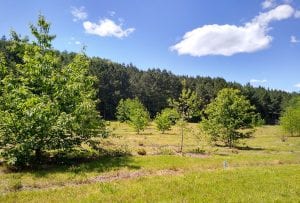
The Henry backcross orchard after culling.
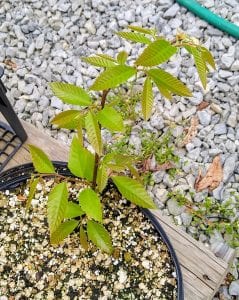
Stump propagated sprout at Berry College.
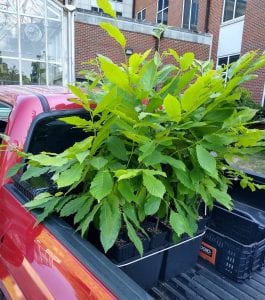
Chinese chestnut rootstocks on their way to be grafted.
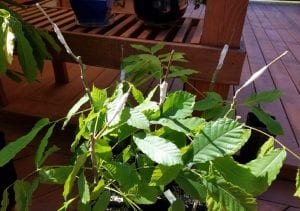
 

A set of grafted trees.
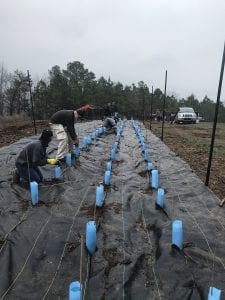
  

Planting the Flint Phytophthora field screening orchard.
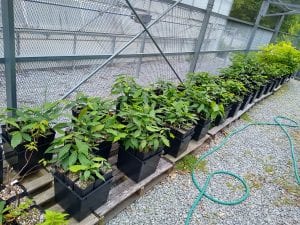
Seedlings at the Berry College nursery.
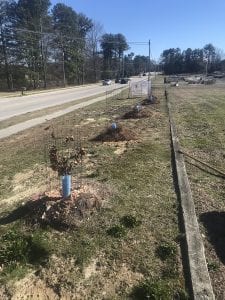
Hybrid chestnuts at Chestnut Grove church (these were planted last year, but more were added in 2020)
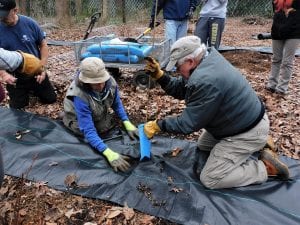
Dale Higdon instructs volunteers at the Briarlake Forest demostration site.
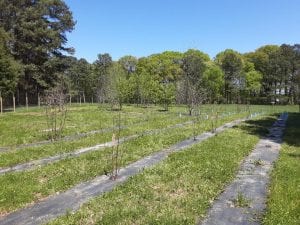
Scott Frazier’s Bottomlands Farm backcross orchard just after culling.
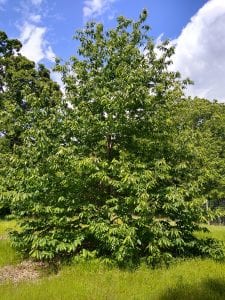
Berry College tree #297, our best backcross tree in this site.
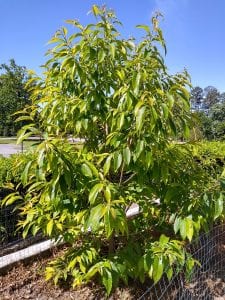
A pure American chestnut showing catkins at the Berry College germplasm conservation orchard.


Georgia News Chapter Menu

Georgia Facebook

Comments Box SVG iconsUsed for the like, share, comment, and reaction icons

Did you know that private landowners - even homeowners with a big backyard - can help support GA-TACF by planting trees on our behalf? Here are just two examples, one a two year old tree planted in Paul Burks' backyard in Atlanta and one a 6 year old tree planted in Scott Frazier's Bottomlands orchard near Taylorsville. Looking good guys!

Read more about planting trees with us here: tacf.org/ga-news/so-you-want-to-plant-some-chestnuts/

The American Chestnut Foundation
Berry College
... See MoreSee Less

Did you know that private landowners - even homeowners with a big backyard - can help support GA-TACF by planting trees on our behalf? Here are just two examples, one a two year old tree planted in Paul Burks backyard in Atlanta and one a 6 year old tree planted in Scott Fraziers Bottomlands orchard near Taylorsville. Looking good guys!Read more about planting trees with us here: https://tacf.org/ga-news/so-you-want-to-plant-some-chestnuts/The American Chestnut Foundation Berry CollegeImage attachment

2 CommentsComment on Facebook

Beautiful form on that second tree

I have room to plant American Chestnut trees! I would definitely plant them, just tell me how to get them.

We want to thank all of the volunteers who helped us this pollination season which is now complete! We were able to bag and pollinate 10 different trees (a record for or us) plus we collected pollen from a number of other trees. This work is crucial for our Best X Best (or RGS) chestnut disease resistance breeding program. Altogether, over the past three weeks, we have had 20 different volunteers plus several more who volunteered but had their shifts cancelled due to weather. We thank all of you! GA-TACF is an all-volunteer organization except for a few interns that are obligated to certain orchard sites (Flint, Hurricane Creek).

Our next major volunteer efforts will start in mid-September when we will harvest and shuck burs and tabulate our harvest. Please stay tuned for announcements about these opportunities! Click here to register to volunteer with us or to sign the volunteer waiver form if you have not already done so: theamericanchestnutfoundation.volunteerlocal.com/volunteer/?id=99170

Here are a few more photos of our final two days when we were assisted by Berry College students who are working in Dr. Adrienne Ernst's lab this summer.

The American Chestnut Foundation
Berry College
... See MoreSee Less

We want to thank all of the volunteers who helped us this pollination season which is now complete!  We were able to bag and pollinate 10 different trees (a record for or us) plus we collected pollen from a number of other trees.  This work is crucial for our Best X Best (or RGS) chestnut disease resistance breeding program.  Altogether, over the past three weeks, we have had 20 different volunteers plus several more who volunteered but had their shifts cancelled due to weather.  We thank all of you!  GA-TACF is an all-volunteer organization except for a few interns that are obligated to certain orchard sites (Flint, Hurricane Creek).  Our next major volunteer efforts will start in mid-September when we will harvest and shuck burs and tabulate our harvest.  Please stay tuned for announcements about these opportunities! Click here to register to volunteer with us or to sign the volunteer waiver form if you have not already done so: https://theamericanchestnutfoundation.volunteerlocal.com/volunteer/?id=99170Here are a few more photos of our final two days when we were assisted by Berry College students who are working in Dr. Adrienne Ernsts lab this summer.The American Chestnut FoundationBerry CollegeImage attachmentImage attachment+3Image attachment

1 CommentComment on Facebook

Great photos...wish I were there to help with this....I got experience operating one of those boon lifts last year!

Here is a short YouTube video showing how we process catkins and store pollen for chestnut breeding purposes. Pollens processed like this are being used in this summer's Best X Best breeding program.

We are still looking for assistance from chapter volunteers for this program!

Volunteers need not have experience; essential safety and pollination training will be provided at the start of each shift. Our next dates will be Tuesday June 9 and Wednesday June 10 (9 am - noon, and 1 - 5 pm shifts). We can only pollinate when it is not raining, but despite the chance of rain on those days we need to make an attempt at it. Our fallback "rain delay" date will be Thursday June 11. Harvest will take place in September and October when we again will need volunteer help.

If you have not already registered to volunteer with GA-TACF, please do so here: theamericanchestnutfoundation.volunteerlocal.com/volunteer/?id=99170

After you have registered, please sign up for pollination shifts here: theamericanchestnutfoundation.volunteerlocal.com/volunteer/?id=113887

I hope you will be able to help!

The American Chestnut Foundation Berry College
... See MoreSee Less

Video image

1 CommentComment on Facebook

Great video, Martin! Interesting and informative!

Load more