Georgia News

News on Wild American Chestnut Search

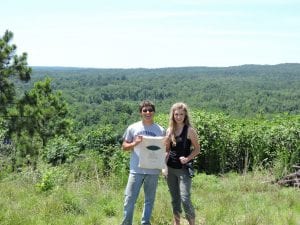
William Walker and Natalie Bailey at Sprewell Bluff WMA, Meriwether County, GA. Photo by John Patten Moss.

The Search for American Chestnuts in Georgia Expands

This spring and summer, GA-TACF has focused much attention on our ~14 year effort to locate and collect data on American chestnuts occurring naturally in the state of Georgia.  This year, the organization is also contributing leaf samples to TACF’s Landscape Genomic study of American chestnuts.  This project seeks a sample of leaves from about 1000 American chestnut trees across the native range. The objectives of the study are to quantify geographic patterns of genetic diversity in remnant American chestnut populations and to test for associations between genetic variation and climate and soil variables across the historical range.  TACF hopes that results will inform efforts to incorporate trees into the breeding program that represent the genetic diversity and adaptive capacity within the native C. dentata population.  For Georgia, the goal was to collect from at least 30 trees in at least 6 diverse locations in the state.  So far, we have collected samples from Brasstown Bald (Union/Towns Co.), Springer Mountain (Gilmer/Fannin/Lumpkin Co.), Fort Mountain (Murray Co.), Tray Mountain (White Co.), Lavender Mountain (Floyd Co.), Johns Mountain and Chestnut Flats area (Walker Co.), Rabun Bald (Rabun Co.), Sprewell Bluff (Meriwether Co.), Pine Mountain (Harris Co.), Lookout Mountain and Cloudland Canyon (Dade Co.), Flint property (Cherokee Co.), Chattahoochee River – Sope Creek area (DeKalb Co.), Stone Mountain (Fulton Co.), Dalton State College (Whitfield Co.) and Kennesaw State University’s Hickory Grove Farm (Cobb Co.).
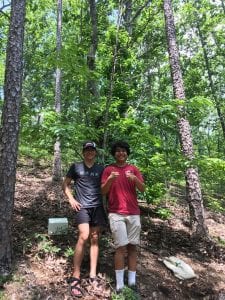
William Walker and Tejas Reddy standing in front of newly discovered American chestnut sprouts on Lavender Mountain, Berry College. Photo by John Patten Moss.

If you know of verifiable American chestnuts in locations other than those indicated above, please contact us at moc.liamg@tuntsehcag!  Or, download the TreeSnap app and use the American chestnut module to report trees and upload images and location data.

In addition to sampling from known American chestnuts in the field, stem samples are being taken from all newly found trees for morphological analysis and these data have been added to dentataBase.  Since Georgia represents the southernmost extent of the native range of American chestnut and is home to the center of known genetic variation in the form of unique chloroplast genotypes (“type M” haplotypes), capturing a good sample of Georgia trees may be particularly important. C. dentata genotypes adapted to southern climates may also be particularly important for planning restoration in response to climatic changes that are expected to shift the species’ range northward.  For these reasons, GA-TACF is attempting to contribute more than the requested 30 samples, and has so far contributed 50 C. dentata samples to the program.
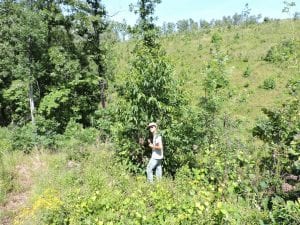
William Walker measures a newly discovered American chestnut at Sprewell Bluff WMA, Meriwether County, GA. Photo by John Patten Moss.

Board member and collaborator Ana Metaxas might also have found some very large representatives of what some have called C. pumila var. alabamensis or C. alabamensis, a tree-form chinquapin similar to C. pumila var. ozarkensis or C. ozarkensis (Ozark chinquapin).  One tree is 24 inches in diameter-at-breast height and about 60 ft tall!  Ana wil be working with Hill Craddock and Taylor Perkins of UT-Chattanooga to confirm this identity.

William Walker, Tejas Reddy, and Natalie Bailey standing with newly discovered American chestnut sprouts on Lavender Mountain, Berry College. Photo by John Patten Moss.


Students involved in this summer’s work include John Patten Moss, William Walker, and Natalie Bailey, all interns with Dr. Martin Cipollini at Berry College, and Tejas Reddy, a Darlington High School student who has been shadowing the Berry College team this summer.  Several others assisted in the field this summer, including Beth Johnson (and her six children!).
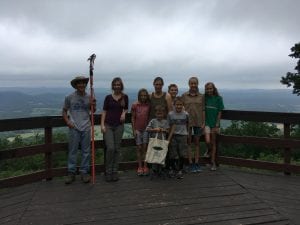
William Walker, Natalie Bailey, and the Johnston family at the John’s Mountain Overlook after collecting data on some newly discovered American chestnut trees along the nearby Pinhoti Trail. Photo by John Patten Moss.




Georgia News Chapter Menu

Georgia Facebook

Comments Box SVG iconsUsed for the like, share, comment, and reaction icons

Did you know that private landowners - even homeowners with a big backyard - can help support GA-TACF by planting trees on our behalf? Here are just two examples, one a two year old tree planted in Paul Burks' backyard in Atlanta and one a 6 year old tree planted in Scott Frazier's Bottomlands orchard near Taylorsville. Looking good guys!

Read more about planting trees with us here: tacf.org/ga-news/so-you-want-to-plant-some-chestnuts/

The American Chestnut Foundation
Berry College
... See MoreSee Less

Did you know that private landowners - even homeowners with a big backyard - can help support GA-TACF by planting trees on our behalf? Here are just two examples, one a two year old tree planted in Paul Burks backyard in Atlanta and one a 6 year old tree planted in Scott Fraziers Bottomlands orchard near Taylorsville. Looking good guys!Read more about planting trees with us here: https://tacf.org/ga-news/so-you-want-to-plant-some-chestnuts/The American Chestnut Foundation Berry CollegeImage attachment

2 CommentsComment on Facebook

Beautiful form on that second tree

I have room to plant American Chestnut trees! I would definitely plant them, just tell me how to get them.

We want to thank all of the volunteers who helped us this pollination season which is now complete! We were able to bag and pollinate 10 different trees (a record for or us) plus we collected pollen from a number of other trees. This work is crucial for our Best X Best (or RGS) chestnut disease resistance breeding program. Altogether, over the past three weeks, we have had 20 different volunteers plus several more who volunteered but had their shifts cancelled due to weather. We thank all of you! GA-TACF is an all-volunteer organization except for a few interns that are obligated to certain orchard sites (Flint, Hurricane Creek).

Our next major volunteer efforts will start in mid-September when we will harvest and shuck burs and tabulate our harvest. Please stay tuned for announcements about these opportunities! Click here to register to volunteer with us or to sign the volunteer waiver form if you have not already done so: theamericanchestnutfoundation.volunteerlocal.com/volunteer/?id=99170

Here are a few more photos of our final two days when we were assisted by Berry College students who are working in Dr. Adrienne Ernst's lab this summer.

The American Chestnut Foundation
Berry College
... See MoreSee Less

We want to thank all of the volunteers who helped us this pollination season which is now complete!  We were able to bag and pollinate 10 different trees (a record for or us) plus we collected pollen from a number of other trees.  This work is crucial for our Best X Best (or RGS) chestnut disease resistance breeding program.  Altogether, over the past three weeks, we have had 20 different volunteers plus several more who volunteered but had their shifts cancelled due to weather.  We thank all of you!  GA-TACF is an all-volunteer organization except for a few interns that are obligated to certain orchard sites (Flint, Hurricane Creek).  Our next major volunteer efforts will start in mid-September when we will harvest and shuck burs and tabulate our harvest.  Please stay tuned for announcements about these opportunities! Click here to register to volunteer with us or to sign the volunteer waiver form if you have not already done so: https://theamericanchestnutfoundation.volunteerlocal.com/volunteer/?id=99170Here are a few more photos of our final two days when we were assisted by Berry College students who are working in Dr. Adrienne Ernsts lab this summer.The American Chestnut FoundationBerry CollegeImage attachmentImage attachment+3Image attachment

1 CommentComment on Facebook

Great photos...wish I were there to help with this....I got experience operating one of those boon lifts last year!

Here is a short YouTube video showing how we process catkins and store pollen for chestnut breeding purposes. Pollens processed like this are being used in this summer's Best X Best breeding program.

We are still looking for assistance from chapter volunteers for this program!

Volunteers need not have experience; essential safety and pollination training will be provided at the start of each shift. Our next dates will be Tuesday June 9 and Wednesday June 10 (9 am - noon, and 1 - 5 pm shifts). We can only pollinate when it is not raining, but despite the chance of rain on those days we need to make an attempt at it. Our fallback "rain delay" date will be Thursday June 11. Harvest will take place in September and October when we again will need volunteer help.

If you have not already registered to volunteer with GA-TACF, please do so here: theamericanchestnutfoundation.volunteerlocal.com/volunteer/?id=99170

After you have registered, please sign up for pollination shifts here: theamericanchestnutfoundation.volunteerlocal.com/volunteer/?id=113887

I hope you will be able to help!

The American Chestnut Foundation Berry College
... See MoreSee Less

Video image

1 CommentComment on Facebook

Great video, Martin! Interesting and informative!

Load more